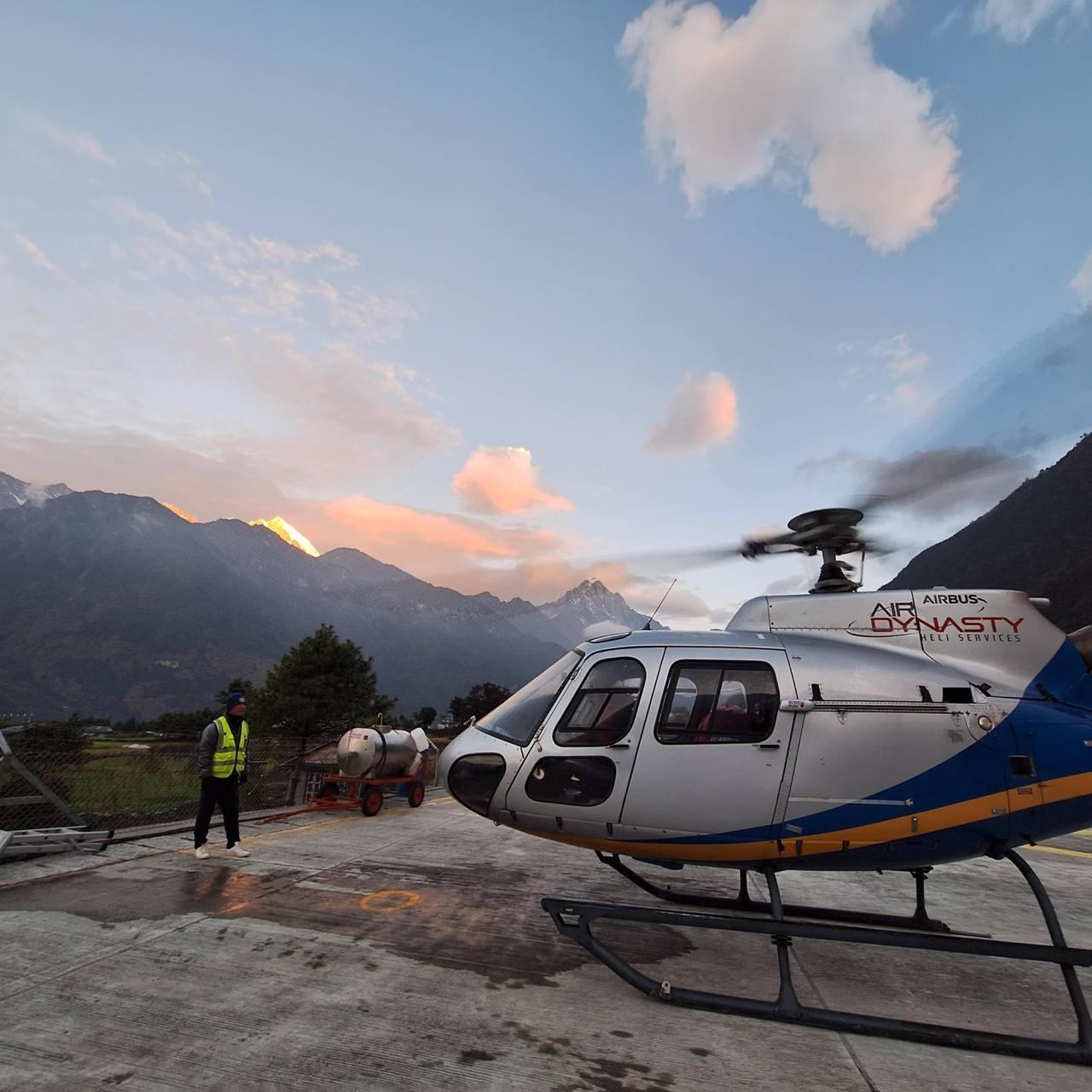
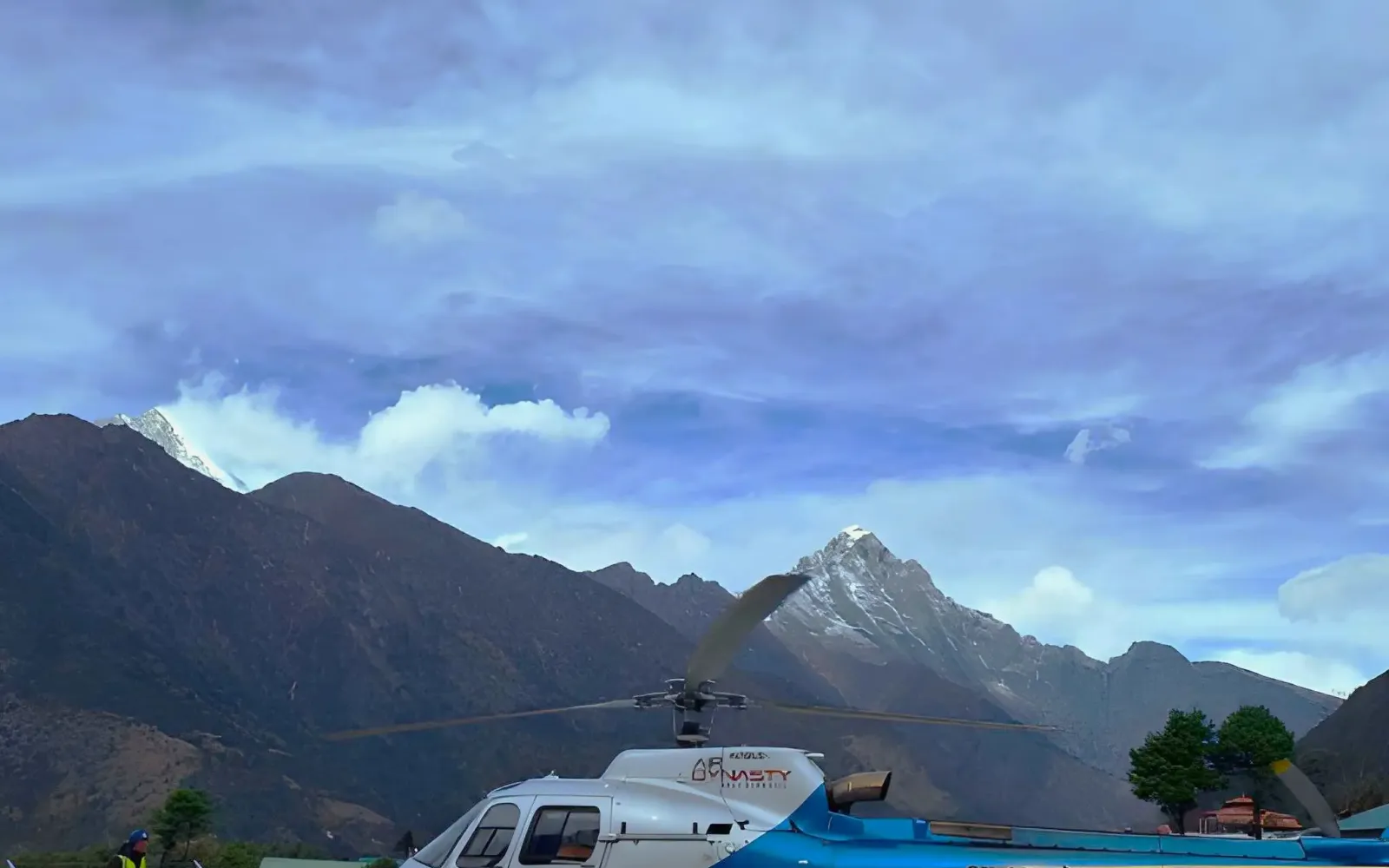
At the Kala Patthar landing zone, elevation 5,545 meters, early morning ground temperatures commonly fall between negative 15 and negative 25 degrees Celsius, a range consistently reported across operator flight logs and confirmed by the automated high-altitude weather station the Ev-K2-CNR Pyramid network operates directly at Kala Patthar. This is not a minor detail. It governs what passengers wear, how long the aircraft stays on the ground, and how the flight is planned from the first minute of the day. This guide sets out exactly what an Everest helicopter tour in winter involves: the aircraft performance physics that make winter flying smoother, the Civil Aviation Authority of Nepal (CAAN) rules that shape passenger numbers and landing decisions, the medical reality of ascending to extreme altitude in under an hour, and the practical preparation needed to make the flight both safe and comfortable.
Nepal's tourism and aviation industries generally define winter as the period from early December to the end of February. Meteorologically, this is the country's driest season: the summer monsoon has long since cleared, and the pre monsoon haze that builds up by late spring has not yet formed. The result is the sharpest air of the year at altitude, even though it is also the coldest. Trekking guides and Himalayan weather summaries commonly report daytime highs in the Khumbu valleys of roughly 10 to 17 degrees Celsius in winter, dropping to well below freezing overnight and before sunrise at higher elevations. At Kala Patthar and Everest Base Camp elevations, the temperature swing is far more severe, with early morning readings regularly falling to negative 15 to negative 25 degrees Celsius before the sun clears the ridgeline.
The other defining feature of winter in Kathmandu is fog, not snow. Tribhuvan International Airport's domestic terminal, the departure point for every Everest helicopter tour in winter, is prone to radiation fog on winter mornings, a well documented seasonal pattern at the airport. Flights are frequently held on the ground until visibility clears, sometimes by mid morning, which is the single largest source of schedule disruption during this season and the main reason operators recommend booking a winter flight early in a traveler's itinerary rather than on the final available day.
The primary reason to book an Everest Overfly helicopter tour in winter is sky clarity. With the monsoon moisture gone and pre monsoon dust yet to accumulate, the Khumbu sees some of its cleanest air of the year. Photographs taken from Kala Patthar or on approach to Everest Base Camp in December and January routinely show a depth of field that spring and early autumn flights cannot match, because haze and afternoon cumulus buildup, both common in the shoulder seasons, are largely absent in winter. Pilots and operators across the region consistently note that winter mornings offer some of the most stable, cloud free viewing windows of the entire flying calendar, provided the aircraft can get airborne past the morning fog.
Seasonal visitor swings in Sagarmatha National Park are well documented. Published park entry figures for 2023, for example, recorded 6,590 visitors in April against 13,681 in May, and 8,551 in October against 11,479 in November, illustrating how sharply arrivals climb through the peak trekking windows of spring and autumn. Winter registers only a fraction of those numbers, since the combination of cold and the perception of unreliable flying conditions keeps most trekking traffic away. For a helicopter passenger, this translates directly into a quieter Kala Patthar landing zone, shorter queues at the domestic terminal check in counter, and none of the helipad congestion that peak season group flights can experience.
This is a genuine aerodynamic advantage, not marketing language. Air density increases as temperature drops, and denser air gives a helicopter's main rotor more mass to generate lift from with each revolution. The Airbus H125 (formerly marketed as the AS350 B3e), the aircraft family most commonly used for high altitude Himalayan tourism flights and the type that set the world record for the highest helicopter landing and takeoff, on the summit of Mount Everest itself in 2005, is specifically engineered for high altitude, hot and cold performance envelopes. In winter's colder, denser air, the same aircraft and engine deliver a wider performance margin than they do on a warm spring afternoon, which translates into steadier handling and more predictable power reserves during the approach to Kala Patthar. Thermal turbulence caused by solar heating of the valley floor, a common feature of spring and early autumn afternoons, is also largely absent during winter morning departures.
Lower winter passenger volume reduces daily fleet utilization for every operator flying the Everest corridor. Aircraft and crews that would otherwise sit idle between bookings are more frequently offered at promotional or flexible group sharing rates during December, January and early February. This is a direct function of supply and demand rather than a discount gimmick: fewer travelers booking the route means operators compete harder on price and availability to keep aircraft flying, which benefits travelers willing to accept winter's cold and its fog related scheduling flexibility.
Late autumn peaks can appear as bare rock in years with a dry pre winter period, since snowfall has not yet built up. Winter storms reliably blanket the entire Khumbu, including Namche Bazaar, Tengboche and the approach ridges to Kala Patthar, in a continuous layer of snow. The visual contrast between deep blue winter sky, unbroken white terrain, and the dark ice walls of Lhotse and Nuptse is a look that is simply unavailable in the other three seasons.
None of the above benefits erase the physical difficulty of flying to extreme altitude in sub zero conditions. The same cold that sharpens the view creates five specific operational constraints that shape how the tour is planned and executed.
Ground temperatures at Kala Patthar frequently sit between negative 15 and negative 25 degrees Celsius in the early morning, and wind chill off the surrounding glaciers can push the effective temperature several degrees lower. Exposed skin is at risk of frostbite within minutes without proper insulation. This is the single largest reason operators restrict ground time at the landing zone to short, fixed windows rather than open ended stops.
Lithium ion batteries lose capacity rapidly in sub zero air. Smartphones and cameras that read a full charge at the hotel can shut down within minutes of exposure at 5,545 meters. Devices kept inside an inner jacket layer, close to body heat, and removed only to capture a photo retain far more usable charge than devices carried in an outer pocket or bag for the full ground stop.
Radiation fog over the Kathmandu valley on winter mornings is a documented, recurring pattern at Tribhuvan International Airport, and it is the leading cause of delayed departures for any Everest helicopter tour in winter. A hold of one to three hours on the ground in Kathmandu is common during December and January, which is why operators including Aero Connect Nepal advise booking the flight for the earliest possible morning of a traveler's Nepal itinerary, leaving two or three buffer days for a reschedule if fog pushes the original slot past the safe flying window.
Check out Nepal weather in July and August, to determine apporprate time to get best experience of helicopter tour.
Thin air at extreme altitude reduces the maximum weight a helicopter can safely lift, a straightforward consequence of density altitude physics: as air thins, rotor blades generate less lift per revolution, so total aircraft weight, fuel, and passenger load must be reduced to compensate. Under Aero Connect Nepal's current operating protocol, flights carry a maximum of four passengers per helicopter in monsoon, compared with five passengers during the seasons like winter, spring and autumn seasons. This is a direct, CAAN aligned precaution against the reduced air density and colder engine performance margins winter introduces, and it applies to the standard Everest Base Camp helicopter tour with Kala Patthar landing. Weather permitting, the aircraft lands directly at Kala Patthar in winter; on days when wind or visibility at that elevation falls outside safe operating margins, the flight is adjusted to a closer approach or rescheduled entirely, never flown outside CAAN safety limits.
Winter days in Nepal are measurably shorter than summer days, and the sun clears the eastern ridgelines later in the morning. Combined with fog holds in Kathmandu, this leaves a narrower daily window in which the flight, the Kala Patthar landing, and the return leg must all be completed before afternoon winds increase and daylight fades. A fog delay that pushes departure too far back can result in the flight being rescheduled to the following morning rather than flown later the same day.
The standard winter itinerary begins with an early hotel pickup in Kathmandu, typically around 5:45 AM, timed to reach the domestic terminal well before the morning fog window. Takeoff, fog permitting, follows shortly after 6:30 AM. The aircraft flies east over the terraced Kathmandu valley hills toward Lukla for a mandatory refueling stop, then continues deeper into the Khumbu, passing over Namche Bazaar en route to the Kala Patthar approach. Under current CAAN aligned protocol, the aircraft carries its full winter passenger load, up to four people for some conditions such as possible bad weather or thinned air, and proceeds to Kala Patthar as a single group where weather allows, landing at the 5,545 meter viewpoint for a short, fixed ground stop before returning toward Lukla and Kathmandu.
Breakfast at altitude is not included in this itinerary. Travelers who want a landing with a hot meal and extended time at a lower, more sheltered elevation are better served by Aero Connect Nepal's dedicated Kongde helicopter tour with breakfast, which is built specifically around that experience rather than treating it as an add on to the Kala Patthar flight. For travelers who are not set on a landing at all, and who prioritize budget or a lower altitude profile, the Everest helicopter overfly scenic flight covers the same core mountain views without the high altitude ground stop, while the Hotel Everest View helicopter tour offers a landing at a lower, more temperate elevation with hotel infrastructure on site.
Kala Patthar sits at 5,545 meters. In high altitude medicine, elevations above 5,500 meters are classified as extreme altitude, the most physiologically demanding tier above the "very high altitude" band that begins at 3,500 meters, a classification used throughout current international mountain rescue medicine guidance from ICAR MedCom. A helicopter ascent from Kathmandu, at roughly 1,400 meters, to Kala Patthar takes under an hour, which bypasses the gradual acclimatization process the body would normally use to adjust to falling oxygen pressure over days of trekking. This is precisely why ground time at the landing zone is kept short. Peer-reviewed research on altitude sickness risk factors shows acute mountain sickness typically develops six to twelve hours after arrival at altitude in unacclimatized individuals, well outside the ten to fifteen minute window passengers actually spend on the ground at Kala Patthar, but the combination of cold, thin air, and physical exertion at that elevation still warrants caution for anyone with underlying cardiac or respiratory conditions, as regional guidance on managing high-altitude illness in Nepal and Bhutan notes.
The Himalayan Rescue Association, which has operated high altitude aid posts in the Khumbu since 1973, including one at Pheriche directly beneath the Kala Patthar approach, documents that altitude illness risk scales with the rate of ascent and the elevation reached, not simply time spent at altitude. This is the medical basis for keeping the winter landing brief, for the aircraft's engine remaining active throughout the ground stop to prevent cold soak related mechanical issues, and for every Aero Connect Nepal flight carrying emergency oxygen for rapid response if a passenger shows symptoms.
Every Everest helicopter tour in winter operated by Aero Connect Nepal runs under the licensing and oversight of the Civil Aviation Authority of Nepal, the country's sole air traffic regulator. The aircraft type most commonly deployed on this route, and as per Aviatize: the Airbus H125 (previously the AS350 B3e), has a maximum takeoff weight in the range of 2,250 to 2,370 kilograms and a single Safran Arriel 2D turboshaft engine rated at 952 shaft horsepower at takeoff, giving it a certified operational ceiling around 23,000 feet, well above the 18,192 foot elevation of Kala Patthar. This is the same aircraft family that performed the record setting landing and takeoff on the summit of Everest itself in 2005, a credential that reflects the type's specific engineering for thin, high altitude air rather than a general purpose airframe adapted after the fact.
None of that changes the arithmetic of density altitude. As air thins with elevation and drops in temperature further reduces air pressure at a given altitude in the opposite direction from what many travelers assume, rotor lift per revolution still falls at extreme elevation, and CAAN safe operating margins require a reduced passenger and fuel load to compensate. This is the direct source of the winter five to four passenger limit described above for some conditions, and of the periodic public disputes in recent years between CAAN, Sagarmatha National Park authorities, and local Khumbu municipalities over landing frequency and passenger numbers at Kala Patthar disputes covered by New Business Age and The Kathmandu Post that have at times resulted in temporary landing restrictions before flights resumed under CAAN's continued jurisdiction. Travelers booking any Everest helicopter tour in winter should expect these operating parameters, weight limits, group size, and landing eligibility, to be confirmed against current CAAN helicopter safety standards at the time of departure rather than treated as fixed indefinitely.
Preparation for a winter flight does not require alpine climbing gear, but it does require a functional layering system built around one rule: no cotton. Cotton absorbs and holds moisture against the skin, which accelerates heat loss the moment the aircraft door opens at Kala Patthar. A three layer system of moisture wicking synthetic or merino wool base layers, a fleece or wool mid layer for insulation, and a windproof, waterproof outer shell rated for sub zero conditions covers the torso adequately for the short ground stop. Insulated, waterproof trekking boots with wool socks, insulated gloves, and a warm hat or beanie round out the core clothing list.
Beyond clothing, three items matter specifically because of the winter altitude and light conditions at Kala Patthar. Polarized, UV rated sunglasses are necessary because ultraviolet exposure is significantly stronger at 5,545 meters than at sea level, and reflection off fresh snow can cause temporary snow blindness within minutes for unprotected eyes. Electronics, phones, cameras, spare batteries and power banks, should be carried inside an inner jacket pocket against body heat and only removed briefly to shoot a photo, given how quickly cold drains lithium ion charge. Hydration the night before departure, without alcohol or excess caffeine, supports the body's ability to handle the rapid, if brief, exposure to reduced oxygen pressure at altitude.
Spring (March to May) and autumn (September to November) remain the most heavily booked seasons for an Everest helicopter tour, and for good reason: milder temperatures, five passenger capacity rather than monsoon's four, and a lower likelihood of the multi hour fog holds that affect Kathmandu specifically in December and January which is the peak winter season. What spring and autumn cannot offer is winter's combination of near total atmospheric clarity, a landing zone largely free of other travelers, and off season group sharing rates driven by lower overall fleet demand. The trade off is straightforward: travelers who can tolerate sub zero ground temperatures for a five to ten minute stop, and who build a flexible one or two day buffer into their Kathmandu itinerary for a possible fog related reschedule, are rewarded with views and solitude that peak season flights, by their own popularity, cannot replicate.
Yes. Cold winter air is denser than warm air, which gives the helicopter's rotor system a genuine aerodynamic advantage and contributes to stable flight characteristics during the morning departure window. Aero Connect Nepal's operating partners fly under Civil Aviation Authority of Nepal licensing, continuously monitor wind speed and visibility at Kala Patthar before committing to a landing, and keep the aircraft engine running throughout the ground stop specifically to prevent cold related mechanical issues.
If morning radiation fog at Tribhuvan International Airport or adverse weather at altitude prevents a safe departure or landing, the flight is rescheduled to the earliest available following morning under Aero Connect Nepal's weather cancellation policy. Travelers whose itinerary cannot accommodate a reschedule are eligible for a full refund under the same policy. This is the specific reason operators recommend booking the flight for the first available morning of a Nepal trip rather than the last.
Ground time at Kala Patthar is limited to roughly in between five to ten minutes specifically because acute mountain sickness typically develops six to twelve hours after arrival at altitude in unacclimatized travelers, well outside that window. The rapid, one hour ascent from Kathmandu to 5,545 meters does bypass normal gradual acclimatization, so the short, fixed ground stop is a direct safety measure rather than an arbitrary limit, and every flight carries emergency oxygen in case a passenger shows early symptoms.
No. The standard Everest Base Camp helicopter tour with Kala Patthar landing does not include a breakfast stop. Travelers who want a landing paired with a hot meal at a lower, more sheltered elevation should book the dedicated Kongde helicopter tour with breakfast instead, which is built around that experience specifically.
An Everest helicopter tour in winter is worth booking for travelers who value atmospheric clarity, a landing zone free of peak season crowds, and off season pricing flexibility over the milder temperatures and slightly higher passenger capacity of spring and autumn. The cold at Kala Patthar is real and must be prepared for with proper layering, and the possibility of a morning fog delay in Kathmandu should be built into the travel schedule with a buffer day or two. For travelers ready to accept those two trade offs, winter delivers views of Everest, Lhotse, Nuptse and the surrounding Khumbu that are, by consistent operator and traveler accounts, the sharpest of the entire year. Full itinerary details, current pricing, and live seasonal availability for the Everest Base Camp helicopter tour with Kala Patthar landing are available directly, and the Aero Connect Nepal team can be reached through the contact page for date specific weather guidance before booking.