The Lobuche-to-Kathmandu helicopter tour is a high-altitude return flight that takes travelers from the Everest region to Kathmandu, replacing several days of trekking and other travel with a much shorter flight. The journey begins at Lobuche, where the helicopter operation depends on the area's elevation, weather, visibility, passenger and baggage weight, and aircraft performance before takeoff. Travelers can then expect changing views of the rugged Khumbu landscape as the helicopter descends toward the Kathmandu Valley.
Unlike a typical sightseeing helicopter flight, this trip is mainly a high-altitude transfer, though it can still offer great views of the Himalayan terrain along the way. The actual experience depends on the aircraft's limits, passenger number and weight, baggage capacity, fuel needs, weather, and the route chosen by the pilot. This guide explains what travelers can realistically expect from departure at Lobuche to landing in Kathmandu, rather than treating the flight as a sightseeing package.
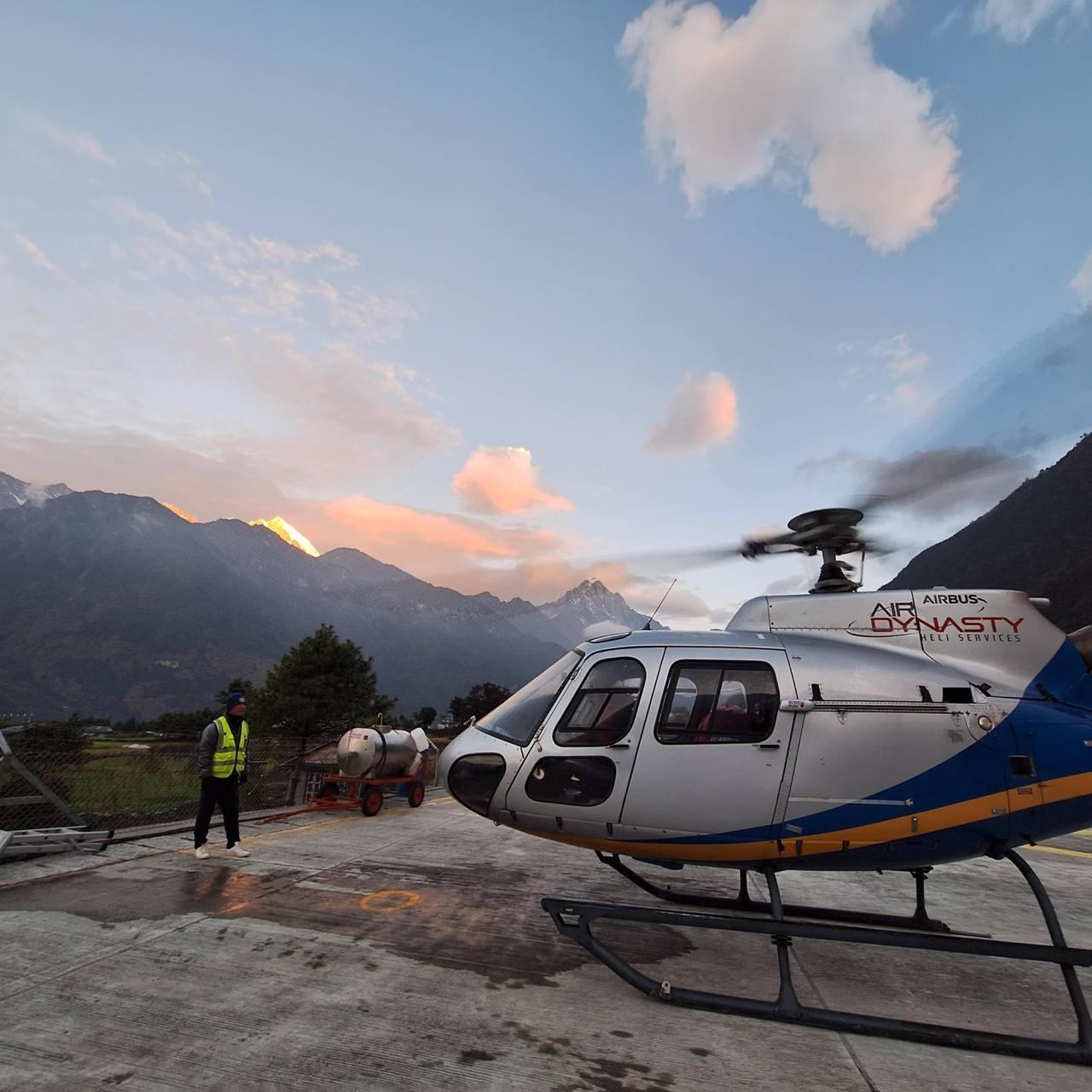
The Lobuche-to-Kathmandu helicopter tour begins at the Lobuche helipad, which is about 4,940 meters above sea level in the Everest region. The helipad is surrounded by rugged mountains, glacier valleys, and some of the area's best-known peaks. Before boarding, passengers pack their bags, complete the required flight checks, and wait for the crew to confirm that the weather and operating conditions are safe for departure.
Taking off from Lobuche requires more careful assessment than a helicopter departure from a lower elevation. The thin air at this altitude affects lift and performance, while passenger weight, baggage, fuel, temperature, wind, and visibility all affect the available payload. The pilot therefore checks the actual conditions before deciding whether the helicopter can safely depart with the planned load.
Before the helicopter leaves Lobuche, several checks are completed to determine whether the planned flight can operate under the conditions of the day. These checks are particularly important at high altitude, where aircraft performance and weather can change the available operating margin.
The total weight of passengers and baggage is an important consideration when departing from Lobuche's high elevation. Passenger capacity is determined by the combined passenger and baggage weight, fuel requirements, temperature, aircraft type, and actual aircraft performance, so the number of passengers that can fly may vary from one flight to another.
Weather conditions are checked not only at Lobuche but also along the planned route and around the destination. Cloud, strong winds, snowfall, and poor visibility can affect the helicopter's ability to depart or continue the planned flight, particularly in the mountainous terrain of the Everest region.
The pilot makes the final decision before takeoff based on the weather, visibility, aircraft performance, passenger load, and route conditions. A confirmed booking does not guarantee departure if conditions are not suitable, and the flight may be delayed or changed if the pilot decides it is not safe to operate.
The better option depends on your onward travel plans. Lobuche to Kathmandu is more convenient if you want to finish your Everest journey quickly and reach the capital directly, while Lobuche to Lukla is a practical choice if you already have onward arrangements from Lukla or want to continue your journey from the Everest region through Lukla.
| Difference | Lobuche to Kathmandu | Lobuche to Lukla |
| Route | Lobuche → Kathmandu | Lobuche → Lukla |
| Best for | Travelers heading directly to Kathmandu | Travelers continuing through Lukla |
| Travel time | Shorter overall journey to the capital | Requires onward travel from Lukla |
| Convenience | More convenient for directtravel to Kathmandul | Useful when Lukla is your next destination |
| Onward travel | Arrive directly in Kathmandu | Arrange a separate flight or journey from Lukla |
| Purpose | Complete the Everest trip and return to the capital | Return to the main gateway of the Khumbu region |
| Best choice when | You have a flight, hotel, or other plans in Kathmandu | You need to reach Lukla for your next travel arrangement |
The flight from Lobuche gives a different view of the Everest region as the helicopter leaves the high mountains and descends toward Kathmandu. Weather, visibility, and the flight route may allow passengers to see peaks such as Mount Everest, Nuptse, Pumori, and Ama Dablam, along with other nearby mountains. From the air, it is easier to see the scale of the peaks, valleys, glaciers, and settlements than from the trekking trail.
One of the most notable parts of the journey is the view of the Khumbu Glacier and the surrounding ice-covered terrain. From above, travelers can see the glacier, moraine-covered ground, rocky slopes, and rugged valleys that shape the upper Everest landscape. Instead of following a narrow trail between mountains, the helicopter gives a wider view of the region, showing how the glaciers and valleys connect at high altitude.
As the helicopter descends, the landscape includes parts of the Khumbu Valley and Sherpa settlements, including areas around Pheriche, Dingboche, Tengboche, and Namche Bazaar, depending on the route and visibility. From above, villages appear within the broader mountain landscape, and trails, cultivated areas, forests, and river valleys are easier to see. These views also show how settlement patterns change as the terrain becomes less severe at lower elevations.
The scenery changes as the helicopter descends toward Kathmandu. The rocky, barren, and glacial landscape around Lobuche slowly gives way to valleys, vegetation, forests, and greener areas at lower altitudes. This is one of the most interesting parts of the journey because passengers can watch the Everest region change from a stark alpine environment to the greener, more developed lower valleys before reaching the Kathmandu Valley.
The helicopter takeoff from Lobuche begins at the high-altitude landing area, surrounded by the rugged mountains and glacial terrain of the Everest region. As the rotors build up power, passengers can see the trekking route and surrounding landscape from a completely different perspective before the helicopter lifts away from the ground. Because Lobuche sits at around 4,940 meters, takeoff performance is different from a helicopter operating at a much lower elevation, with thin air, passenger weight, baggage, fuel, temperature, and aircraft performance all influencing the operation.
Once airborne, the helicopter begins moving away from the immediate Lobuche area and may climb or descend through different sections of the valley depending on the planned route and current conditions. The rocky terrain and glacial landscape gradually open into wider valley views as the aircraft loses altitude, creating a clear contrast with the trail-level experience of trekking. For many travelers, this is the moment when the return journey feels noticeably different: instead of continuing along the footpath, they are leaving the high-altitude trekking environment behind and covering the distance toward Kathmandu by air.
A Lobuche-to-Kathmandu helicopter flight provides a quick connection from the Everest region to Nepal’s capital. The journey begins at Lobuche, at an altitude of around 4,940 meters, and continues toward lower elevations before heading to Kathmandu. Unlike a fixed-wing aircraft, a helicopter can adjust its route according to the terrain, weather, visibility, and operational requirements. This makes the actual flight path flexible rather than a single fixed line on a map.
After departing Lobuche, the helicopter leaves the high-altitude area of the Everest region and gradually moves toward lower elevations. Depending on the day's conditions and approved flight routing, the aircraft may pass through or near areas of the Khumbu Valley before continuing toward lower-altitude airspace. The route is planned with consideration for mountain terrain, weather, visibility, and helicopter performance at high altitude.
Once the helicopter moves out of the higher Khumbu region, it continues toward Kathmandu. The exact route can change from one flight to another. Weather conditions, visibility, air traffic, aircraft performance, and operational requirements can all influence the flight path. The route shown in an itinerary or discussed before departure is the planned route, while the actual path taken by the helicopter may differ during the flight.
The helicopter does not necessarily follow a direct straight-line path between Lobuche and Kathmandu. The Himalayan terrain includes steep valleys, high ridges, and restricted areas that affect flight planning. Clouds, wind, poor visibility, and changing mountain weather may also require the pilot to adjust the route. Airspace restrictions, air traffic, and other operational considerations can further influence the flight path. The pilot therefore follows the safest practical route based on conditions at the time of flight.
A helicopter from Lobuche to Kathmandu is usually much faster than going back by land and scheduled flights. The flight itself is typically about 1–1.5 hours, depending on the aircraft, route, weather, and operating conditions. This is only an estimate, not a guaranteed flight time. The total trip can take longer because of shuttle transfers, passenger and baggage handling, weather delays, refueling if needed, and route changes. Mountain weather can change quickly, so departure or arrival times may shift for safety.
Compared with trekking back from Lobuche, the helicopter saves several days of walking and avoids multiple overnight stops on the trail. Travelers who go by trek and scheduled flights usually need to descend to Lukla first, then fly to Kathmandu. The helicopter is a more direct option, especially for trekkers with limited time or who want to leave the Everest region quickly.
Mountain weather around Lobuche can be very different from conditions in Kathmandu. A sunny morning in the capital does not mean a helicopter can depart from Lobuche. The Everest region has its own weather patterns, and conditions can change quickly with altitude and terrain.
Low clouds can form in the valleys, fog can reduce visibility at the landing area, and strong winds can make high-altitude operations unsafe. Rain or snowfall can also affect visibility and landing conditions. Aero Connect Nepal says its operations team checks aviation forecasts, satellite images, and weather observations across the Khumbu region before confirming a flight.
Because of these changing conditions, a Lobuche to Kathmandu helicopter flight does not operate on a guaranteed fixed schedule. If visibility is poor, winds are too strong, or clouds and precipitation make the route unsuitable, the departure may be postponed until conditions improve. Flights operate only when the required visual flight conditions and operational safety margins are met.
Passengers should allow extra time in their itinerary and be prepared for delays or a rescheduled flight instead of expecting the helicopter to leave at a fixed time. A 24–48-hour buffer is especially advisable if you have an international flight or another time-sensitive connection from Kathmandu. Safety comes first, and the pilot and flight operations team make the final decision based on actual conditions.
The Lobuche-to-Kathmandu helicopter tour is more than a quick way off the Everest trail. It starts at a high-altitude Himalayan settlement and takes you from the rugged Khumbu landscape to lower elevations and Kathmandu, with views of mountains, glaciers, valleys, and villages when visibility is clear. The flight can save several days of downhill trekking, making it a practical option for trekkers with limited time. However, high-altitude helicopter operations require careful planning. Weather, visibility, aircraft performance, passenger weight, landing conditions, and the pilot’s judgment can all affect the final departure, route, and timing.
Aero Connect Nepal can assist with booking and itinerary coordination, helping travelers plan their trip while the actual flight operation remains subject to aviation and safety requirements.
The Lobuche to Kathmandu Shared Helicopter Tour is a return-flight option for trekkers finishing their Everest Base Camp trek. It allows travelers to fly directly from Lobuche toward Kathmandu instead of spending several additional days trekking back through the Khumbu region.
The helicopter departs from a designated landing area in Lobuche that is suitable for the aircraft and current operating conditions. The flight team confirms the departure after checking weather, visibility, wind, and landing conditions.
The tour is designed for a maximum group size of 5 people. Because this is a shared service, passengers may travel with other trekkers heading toward Kathmandu.
When visibility is clear, passengers can enjoy aerial views of Himalayan peaks, glaciers, valleys, and mountain settlements across the Khumbu region. The views depend on the weather and visibility during the flight.
Mountain weather can change quickly. Fog, clouds, strong winds, rain, snowfall, or poor visibility may delay or prevent the flight from operating. The operator checks aviation forecasts and local weather conditions before departure.
Passenger weight is required for the aircraft's weight-and-balance calculation. This is particularly important for high-altitude helicopter operations because thinner air reduces available lifting performance.
At high elevations, helicopter performance is affected by thinner air. When operationally necessary, passengers may be transferred in separate short rotations from designated staging areas to maintain appropriate aircraft performance and safety margins.
The flight duration is not a fixed guaranteed time. Weather, visibility, wind, air traffic, routing, and other operating conditions can affect both the route and duration.
Important documents, medicines, electronics, and other essential personal belongings should be kept easily accessible. The recommended packing list also includes warm clothing, gloves, thermal layers, sunscreen, a power bank, and a charger.
Yes. Travelers can have breakfast at their accommodation in Lobuche before departure, depending on the flight schedule. Because mountain flights can change according to weather and operating conditions, passengers should remain available for updates.