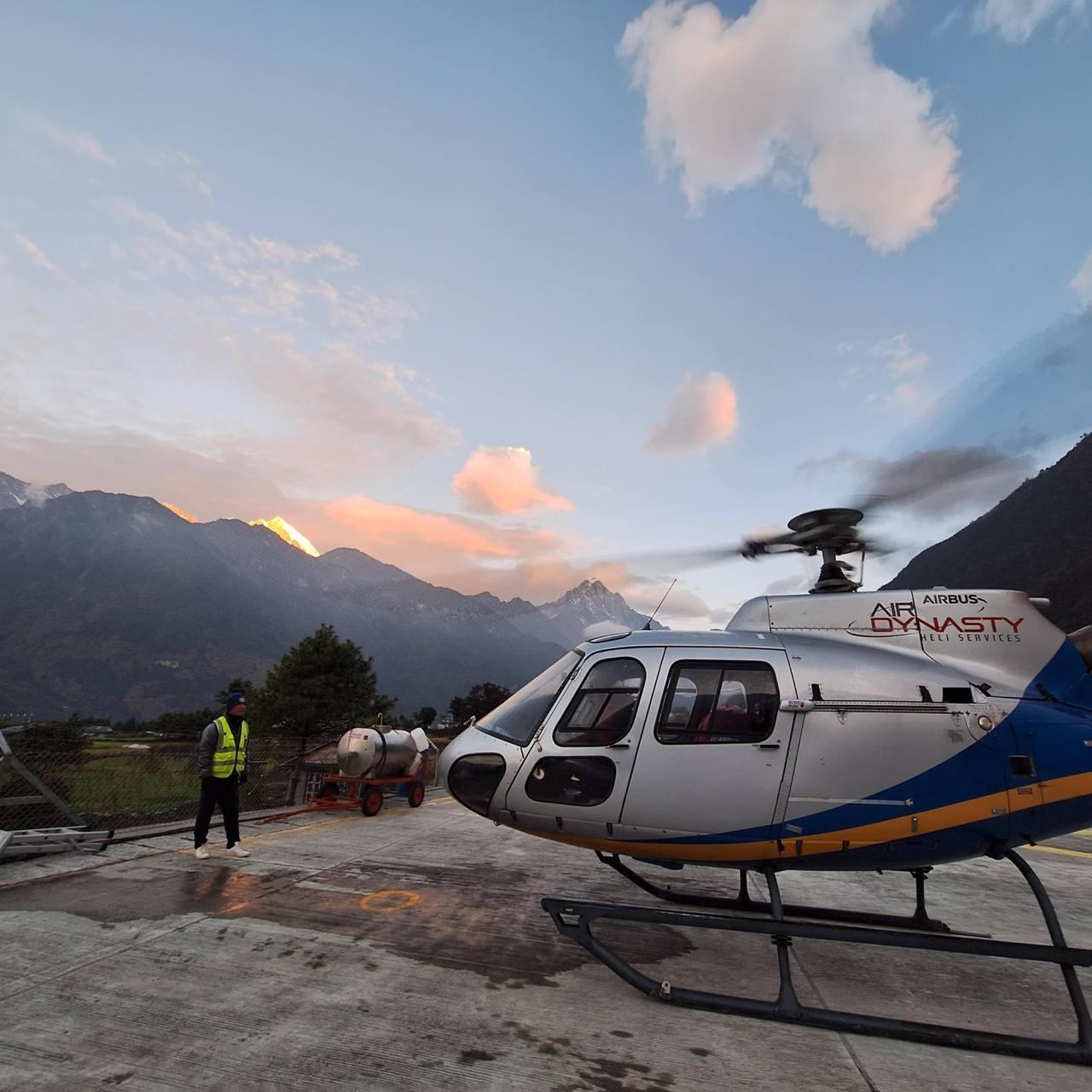
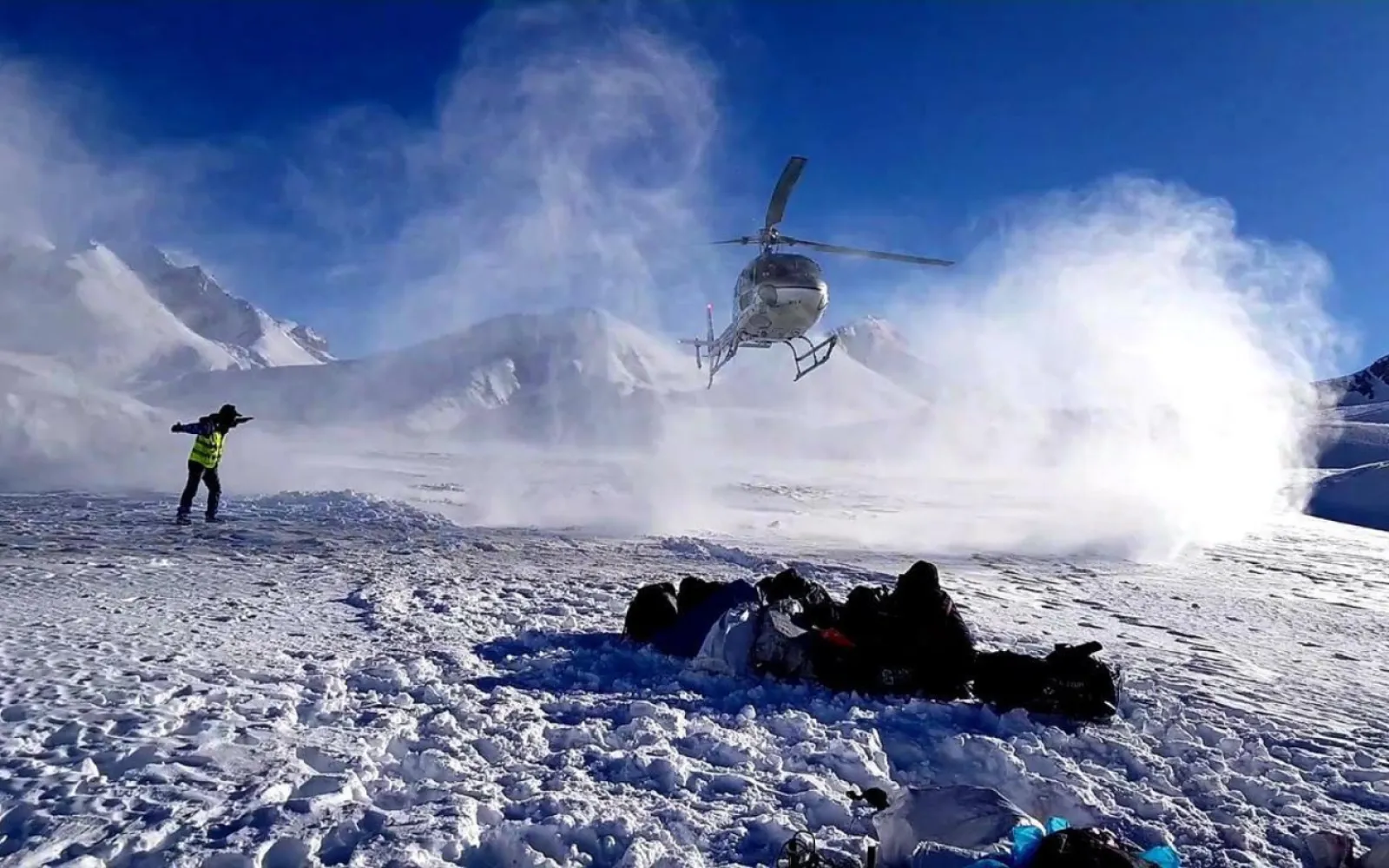
Why helicopters beat fixed-wing aircraft for Mountain Travel in Nepal comes down to how each aircraft operates in difficult terrain. Fixed-wing aircraft need forward speed and a suitable runway for takeoff and landing. Helicopters can take off and land vertically, hover, and use designated landing areas where a conventional airstrip is not practical.
These abilities make helicopters especially useful for remote mountain destinations, sightseeing, rescue operations, and high-altitude areas across Nepal.
The advantages of a helicopter also depend on skilled pilots and careful flight planning. In mountain flying, pilots need to understand altitude, terrain, wind, visibility, aircraft performance, and changing weather.
Navigation depends on planned routes, communication, GPS, and visual references. This does not mean helicopters are always safer than fixed-wing aircraft, but their ability to operate where there are no conventional runways gives them a clear advantage for some Himalayan missions.
This guide explains the differences between the two aircraft, the training needed for mountain helicopter pilots, and the navigation and safety procedures used during flights in Nepal.
Helicopter tours in Nepal are especially useful for mountain operations because they can take off and land vertically without a runway, hover in place, and fly slowly into tight landing areas. This makes it possible to use helipads and suitable mountain landing sites where a fixed-wing airstrip would be impractical. Their ability to operate in a small space is especially helpful for remote destinations, sightseeing flights, medical evacuations, and other operations in Nepal's mountainous terrain.
Fixed-wing aircraft need forward motion to create lift, and they usually need a runway or airstrip for takeoff and landing. They cannot hover or stay still in the air, and they need more space for approach, landing, and departure than a helicopter. In mountainous Nepal, this can make it hard to reach places without airports or airstrips, especially where steep terrain, narrow valleys, and little flat land make runways difficult to build or use. Fixed-wing aircraft are still very effective for moving passengers between airports, but helicopters are more flexible when there is no suitable runway.
Nepal's mountainous geography leaves little flat land for conventional airports and airstrips, especially in remote Himalayan areas. Helicopters do not need long runways, so they are useful for reaching remote villages, mountain destinations, and places without airport infrastructure. Their ability to take off and land vertically also makes them more flexible in difficult terrain.
This flexibility makes helicopters useful for more than tourism. They are well suited to mountain sightseeing and pilgrimage travel, and they can also reach isolated areas for rescue operations, medical evacuations, transport, and logistical work. In each case, operations still depend on good weather, aircraft performance, pilot skill, and an appropriate landing area.
Not every helicopter is suited to the same kind of flying. Aircraft used for mountain tourism, rescue, passenger transport, and other missions are chosen based on altitude performance, payload, range, engine setup, and cabin capacity. This is why the helicopter fleet matters.
For high-altitude operations, the Airbus H125 is a strong example. Airbus describes the H125 as a single-engine, multi-mission helicopter designed for demanding environments. It has a maximum flight altitude of 7,010 meters (23,000 feet), a cruise speed of 252 km/h, and a maximum range of 630 km under the manufacturer's stated conditions. At maximum takeoff weight, its certified out-of-ground-effect hover ceiling is 3,871 meters (12,700 feet).
These figures matter in the Himalayas because helicopter performance drops as altitude increases. Thin air reduces lift and engine power, making takeoffs, landings, and hovering more difficult. A helicopter designed and certified for high-altitude operations therefore has a clear advantage in mountainous terrain.
The H125 can carry one pilot and up to six passengers. Airbus also highlights its use for tourism, passenger transport, search and rescue, law enforcement, and other missions. Its visibility, manoeuvrability, and high-altitude capability make it well suited to remote mountain operations.
The Airbus H145 is another fleet option. It is a twin-engine helicopter with two Safran Arriel 2E engines, a maximum takeoff weight of 3,800 kg, and a recommended cruise speed of 241 km/h. Airbus lists its maximum takeoff and landing altitude at 6,096 meters (20,000 feet). It can carry one or two pilots and up to 10 passengers, depending on the configuration.
The twin-engine design matters from both a technical and operational standpoint. Airbus highlights the H145's performance in one-engine-inoperative conditions, as well as its separate fuel, hydraulic, and electrical systems. It also uses the Helionix avionics suite and a four-axis autopilot to help the pilot manage flight and maintain situational awareness.
The H125 and H145 meet different needs. The H125 is geared toward light, high-altitude, multi-mission operations, while the larger H145 offers more cabin space and twin-engine capability. The best choice depends on the mission, altitude, passenger load, weather, landing site, and operating requirements.
Helicopters are useful in Nepal's mountainous regions, where rough terrain, high altitude, and limited infrastructure can make travel difficult. They can reach remote places, save time, and handle many missions that fixed-wing aircraft cannot.
Helicopters can take off and land vertically. Unlike fixed-wing aircraft, they do not need long runways, so they can use landing areas in mountain regions where airstrips may not exist. This makes helicopter travel useful for reaching remote Himalayan destinations, pilgrimage sites, and high-altitude settlements.
Helicopters can stay in one place in the air, unlike fixed-wing aircraft. This can help during mountain operations when pilots need time to check landing conditions or position the aircraft near tight landing areas. It gives pilots more flexibility in difficult terrain.
Many mountain villages, trekking destinations, and high-altitude landing sites in Nepal are far from regular airports. Helicopters can reach these places without roads or airport infrastructure. They are useful for tourism, logistics, medical support, and travel to hard-to-reach destinations.
Helicopters can fly safely at much lower speeds than fixed-wing aircraft. This allows pilots to make controlled approaches in mountain terrain. They can better adjust their position when flying through valleys, over ridges, and into confined landing areas. Success still depends on pilot experience, weather, terrain awareness, and aircraft performance.
Helicopters can cut travel time compared with long road trips or multi-day trekking routes. Places that may take several days to reach by road and foot can often be reached in a few hours by helicopter. This makes helicopter travel attractive for visitors with limited time and useful for rescue, medical evacuation, supply transport, and other essential services.
Fixed-wing aircraft are very effective for linking established airports, but they have limits in Nepal's mountainous terrain. Because they need runways, forward speed, and suitable airport infrastructure, they cannot offer the same access and flexibility as helicopters in many remote mountain areas.
Fixed-wing aircraft usually need a runway or airstrip for takeoff and landing. In Nepal, remote mountain regions have few flat areas for this kind of infrastructure, so fixed-wing access is limited to places with existing airstrips.
Steep mountains, narrow valleys, and limited open spaces can make fixed-wing operations more difficult. Airports and airstrips in mountainous areas need safe approach and departure paths, and surrounding terrain can limit where conventional aircraft can operate safely.
Fixed-wing aircraft usually use airports and airstrips instead of landing directly at remote destinations. Travelers may need to continue by road or on foot from the nearest airport, which adds travel time to the overall journey.
Fixed-wing aircraft need to keep moving forward to generate lift and cannot hover. They are less maneuverable at low speeds, so they are less flexible when approaching confined mountain areas, while helicopters can slow down and adjust their position during approaches to suitable landing sites.
Helicopters are not always safer than fixed-wing aircraft. In Nepal's mountains, safety depends on pilot experience, aircraft condition, weather, route planning, altitude, and following aviation procedures.
Neither aircraft type is always safer. A flight’s safety depends on the route, pilot training and experience, weather, terrain, aircraft performance, and operating procedures.
Mountain helicopter operations require pilots to handle conditions that can change quickly and vary with altitude and terrain. Rapid weather changes, steep mountains, narrow valleys, high-altitude performance limits, confined landing areas, strong winds, and low visibility all require careful judgment and experienced decision-making. Pilots must keep checking whether the planned route and landing area are still safe as conditions change.
Careful preflight planning, continuous communication, and regular reassessment are essential in this environment. Pilots also need to be prepared to divert, delay, or abort a flight if conditions become unsafe, since flexibility is often the key to managing risk in mountain operations.
Helicopters have clear advantages in mountainous Nepal because they can take off and land vertically, hover, fly slowly, and do not depend on conventional runways. These benefits require well-trained pilots and careful planning, with constant attention to weather, navigation, aircraft performance, and landing-site conditions. For mountain travel, always choose an authorized operator with experienced pilots and strong safety procedures.
Helicopters can take off and land vertically, hover, and operate from designated landing areas where conventional runways are not practical. This makes them useful for reaching remote mountain locations in Nepal.
Yes, helicopters can operate from much smaller designated landing areas than fixed-wing aircraft, which generally require a suitable runway or airstrip. This gives helicopters greater access to remote and mountainous destinations.
Neither aircraft type is automatically safer because safety depends on the aircraft, pilot, weather, route, and operating procedures. Helicopters do have specific advantages in mountain operations because they can maneuver and land without a conventional runway.
The biggest advantage is its ability to access locations that have limited or no conventional airport infrastructure. Helicopters can also hover and operate at low speeds when approaching suitable mountain landing areas.
Helicopters generate lift through their main rotor and can take off and land vertically. They therefore do not need the long runway required by most fixed-wing aircraft.
Mountain helicopter pilots need appropriate helicopter flight training, licensing, and experience for the aircraft and operations they conduct. They also need a strong understanding of mountain flying, weather, terrain, altitude, and aircraft performance.
As altitude increases, air becomes thinner and helicopter performance can decrease. Pilots must consider factors such as aircraft weight, temperature, altitude, and available engine and rotor performance when planning a high-altitude flight.
Mountain conditions can change quickly, while valleys, ridges, winds, and landing areas create challenges that are different from ordinary flight operations. Experience helps pilots assess terrain, weather, aircraft performance, and suitable routes before and during a flight.
Passenger and baggage weight directly affect the helicopter's total payload and performance. Accurate weight information allows the operator to plan the aircraft within appropriate operating limits, which becomes especially important at high altitude.
Pilots consider the size and condition of the landing area, surrounding terrain, wind, elevation, obstacles, and available approach and departure paths. The landing site must be suitable for the helicopter and the conditions at the time of operation.
Pilots use planned routes, aviation charts, communication systems, GPS, and visual references such as valleys, ridges, and other terrain features. Navigation methods are selected according to the flight, weather, aircraft, and operating requirements.
Yes, GPS can be an important navigation aid during helicopter operations. However, pilots do not rely on GPS alone and also use visual references, planned routes, charts, and other available navigation information.
Cloud, rain, wind, fog, and reduced visibility can make mountain navigation more difficult and can obscure terrain and landing areas. Pilots and operators assess weather conditions before and during the flight and adjust operations when conditions are unsuitable.
Pilots assess the changing conditions and may alter the route, slow or stop the operation where appropriate, or return to a safer location. If the required visibility for safe flight cannot be maintained, the flight may be delayed, diverted, or canceled.
Flights can be delayed or canceled because of poor visibility, strong winds, cloud, rain, snow, or other conditions that affect safe operations. In mountain flying, the decision to wait or cancel is based on operating conditions rather than simply keeping to the original schedule.
Emergency equipment varies according to the aircraft and operation, but helicopters may carry equipment designed to support passengers and crew during an emergency. The specific equipment available should be confirmed with the helicopter operator before the flight.
Passengers normally receive instructions about boarding, seating, seat belts, communication, baggage, and emergency procedures before departure. The pilot or ground crew may also provide specific instructions for landing and disembarking at mountain locations.
Passengers should remain seated, follow the pilot or ground crew's instructions, and keep seat belts fastened until they are told it is safe to move. Never approach or leave the helicopter independently during landing or takeoff operations.
Check that the operator is properly authorized and follows the applicable aviation requirements in Nepal. You should also consider pilot experience, aircraft maintenance practices, weather monitoring, safety procedures, and the operator's approach to flight planning.
Check the operator's authorization, aircraft information, pilot experience, itinerary, weather procedures, passenger and baggage requirements, and cancellation policy. You should also confirm what is included in the package and how the operator handles delays or rescheduling caused by weather.