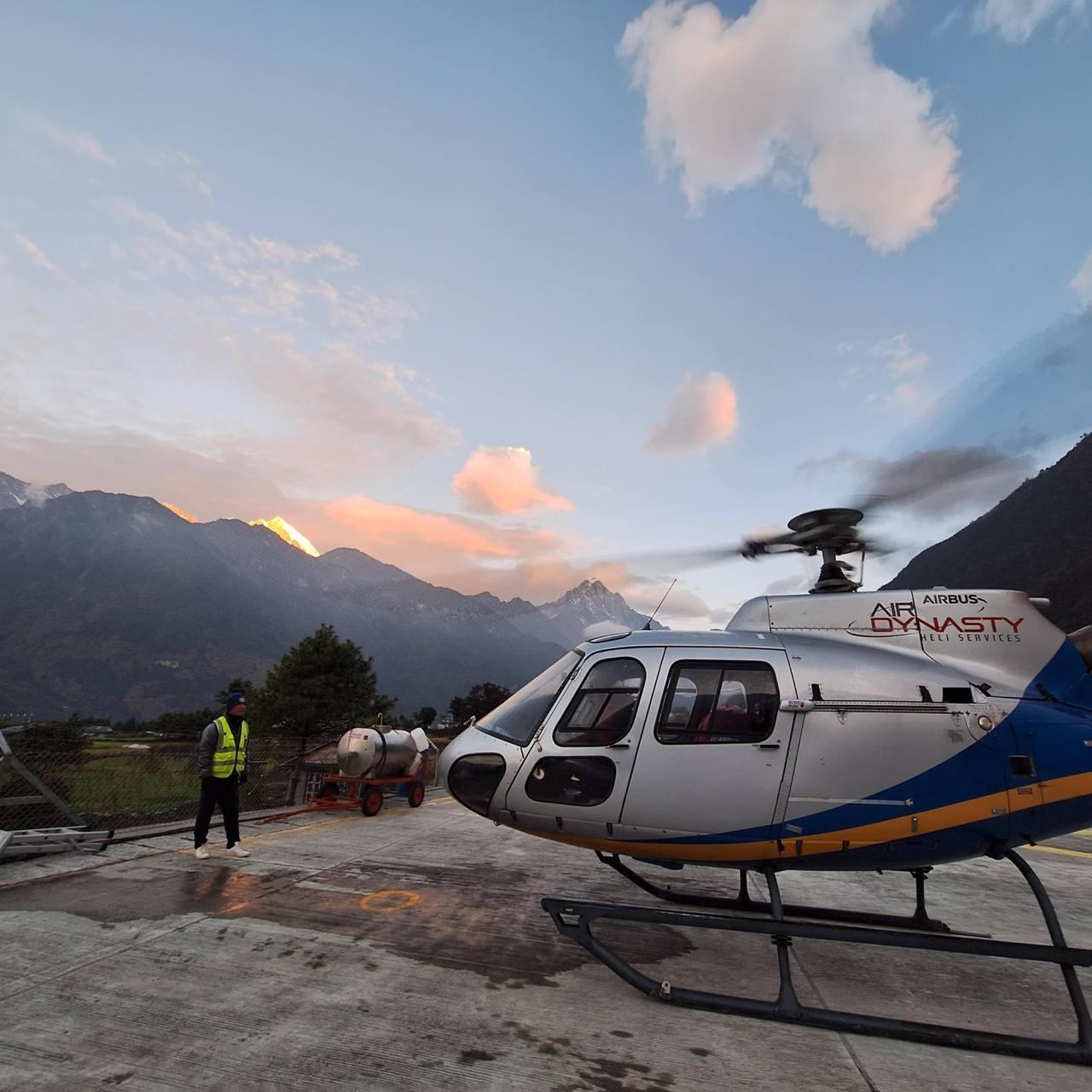
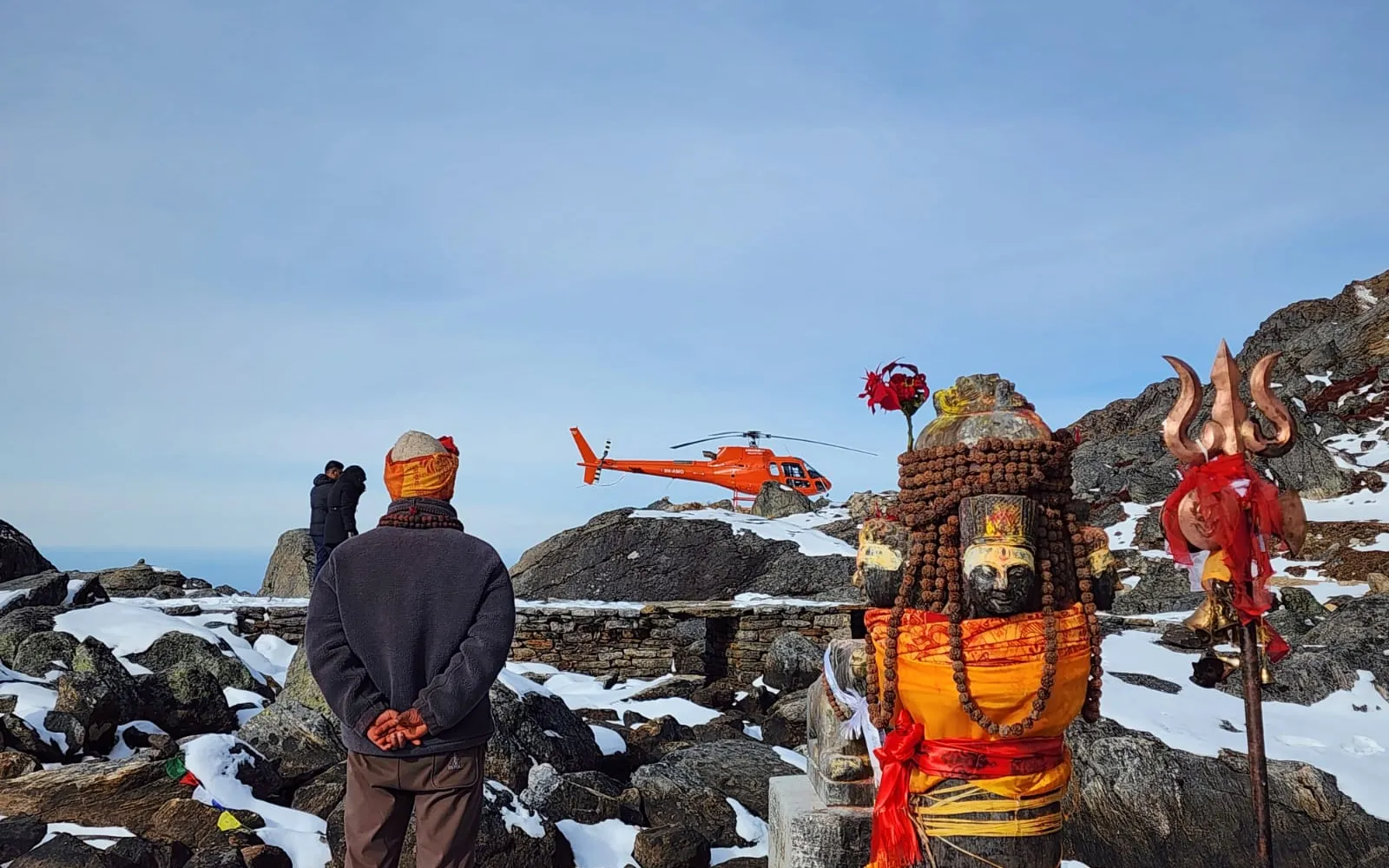
Helicopter safety standards in Nepal are designed to protect passengers before, during, and after every flight. From aircraft maintenance and pilot qualifications to weather checks and operating procedures, every commercial helicopter flight must follow regulations set by the Civil Aviation Authority of Nepal (CAAN). These rules are especially important in the Himalayas, where high elevations, narrow valleys, and rapidly changing weather require careful planning before takeoff.
For most travelers, these safety checks happen behind the scenes. Engineers inspect the helicopter, pilots check the latest weather reports, and ground crews verify passenger weight, fuel needs, and flight routes before departure. If conditions are not safe, the flight is delayed or canceled because safety comes first.
This guide outlines helicopter safety standards in Nepal, who oversees them, what passengers should expect before boarding, and how to choose a compliant operator. Whether you are planning an Everest Base Camp helicopter Overfly tour or a scenic flight over the Annapurna region, understanding these standards can help you make an informed decision before you fly.
The Civil Aviation Authority of Nepal (CAAN) is the government agency that regulates all civil aviation activities, including commercial helicopter operations. CAAN issues Air Operator Certificates (AOCs), licenses pilots and engineers, approves flight operations, and carries out regular safety inspections to make sure operators follow Nepal's Civil Aviation Regulations (NCARs) and Civil Aviation Requirements (CARs). These rules cover aircraft maintenance, pilot qualifications, operating procedures, safety management systems, and accident reporting.
Nepal's helicopter industry also follows international aviation standards set by the International Civil Aviation Organization (ICAO), a United Nations agency. As an ICAO member state, Nepal includes Standards and Recommended Practices (SARPs) in its aviation rules, covering pilot licensing, airworthiness, flight operations, safety management systems, and aviation security. CAAN regularly audits operators and aligns national regulations with ICAO guidance to improve safety across commercial helicopter services.
Helicopter safety depends on far more than the aircraft itself. A safe flight is the result of regular maintenance, experienced pilots, favorable weather, and strict operational procedures working together. Here are a few factors that make a helicopter safe to fly.
Helicopters are regularly inspected and maintained to keep engines, rotor systems, avionics, and other important parts in good working order. Routine checks help identify wear, damage, or technical issues early, and any problems are repaired before the aircraft is cleared to fly.
Professional helicopter pilots receive extensive training and the required certifications. They are trained to handle changing weather, mountain flying, emergencies, and safe decision-making throughout every flight.
Safe helicopter flights depend on good weather. Operators watch wind, visibility, cloud cover, and other conditions before and during the flight, and they delay or cancel trips if conditions are unsafe.
Reputable operators follow clear safety procedures, including pre-flight inspections, passenger briefings, weight and balance checks, and regular communication with air traffic services. These steps help lower risk and keep flights safe.
Helicopters follow strict maintenance schedules based on flight hours and calendar time. Before each flight, pilots check fuel levels, mechanical linkages, and fluids. Regulators require routine maintenance every 50 flight hours, 100-hour inspections for commercial operations, and a full annual inspection every 12 months.
Critical parts such as the main rotor gearbox, turbine engine, and drive shafts are replaced or overhauled at set intervals, such as 300, 500, or 2,500 hours. Maintenance records are essential because they prove the aircraft is airworthy. They also track part life, record service bulletins and Airworthiness Directives, identify recurring problems, and support accountability for safety standards.
Onboard safety equipment is tailored to the flight path and environment, protecting passengers during land and over-water operations. Basic cabin equipment includes seatbelts or multi-point harnesses for each occupant, portable fire extinguishers, first-aid kits, and emergency exit tools such as push-out windows. For over-water flights, helicopters carry life vests, emergency flotation bags attached to the skids or airframe, and multi-person life rafts with survival kits.
For emergency response and navigation, helicopters are also equipped with Emergency Locator Transmitters (ELTs), which broadcast GPS signals to rescue satellites after impact, and advanced avionics such as Helicopter Terrain Awareness Warning Systems (HTAWS) and Flight Data Recorders (black boxes) to improve flight safety.
Before boarding, a quick safety check helps ensure a safe and luxurious flight experience for everyone. While the flight crew handles the mechanical checks, passengers also play an important role in aviation safety on the ground and in the air.
| Safety Check | Why It Matters | Passenger Action |
| Ground Approach Zone | The tail rotor spins rapidly and is virtually invisible, while main rotors tilt downward in gusty conditions. | Always approach and exit from the front or side within the pilot's direct line of sight; never walk near the rear of the aircraft. |
| Securing Loose Items | Rotor wash generates powerful downdrafts that can sweep away unfastened items, turning them into severe engine intake hazards. | Secure hats, scarves, and loose gear inside zipped bags; carry equipment horizontally below waist level rather than over your shoulder. |
| Weight & Balance Verification | Aircraft stability and power limits depend heavily on exact center-of-gravity and payload calculations, especially at high density altitudes. | Provide precise body weight and luggage weights to ground staff, and sit strictly in your assigned seat without moving around. |
| Emergency Equipment & Exits | In an emergency, knowing how to release harnesses and locate survival gear saves critical seconds. | Pay close attention to the pilot's pre-flight briefing, identify emergency door handles, and locate the Emergency Locator Transmitter (ELT), fire extinguisher, and life vests. |
| Seatbelt & Headset Protocol | Turbulence or abrupt maneuvers can cause injury, while high engine noise hinders crew communication. | Fasten multi-point harnesses tightly before engine start, adjust your headset volume, keep the microphone close to your mouth, and leave seatbelts latched until rotors stop. |
| Controls & Door Handling | Accidental contact with dual flight controls or improper door operation can jeopardize aircraft navigation and structural integrity. | Keep hands and belongings completely clear of flight sticks, pedals, and collective levers, and allow crew members to open or close main cabin doors. |
To fly commercially, a helicopter pilot must have a Commercial Pilot License (CPL) or an Airline Transport Pilot License (ATPL) from a civil aviation authority. This requires a Class 1 medical exam, strong ground training in aerodynamics, meteorology, and navigation, and the required flight hours are usually up to 150 to 200 for a commercial license. Pilots must also have a type rating for each helicopter model they fly, with an Instrument Rating (IR) for low-visibility conditions.
Flying in mountainous regions requires special ground and simulator training to prepare pilots for high-altitude conditions where thin air reduces engine performance and rotor lift. Pilots take advanced mountain flying courses that cover density altitude, wind patterns across ridges and canyons, and limited-power takeoffs and landings.
Training also includes canyon turn techniques, handling updrafts and downdrafts, and calculating strict weight-and-payload limits. In addition, pilots hold detailed pre-flight briefings on mountain weather, terrain hazards, and emergency escape routes before flying into challenging alpine areas.
A helicopter flight depends on a team of ground staff working with the pilot. Licensed Aircraft Maintenance Engineers (AMEs) carry out pre-flight inspections, routine checks, and major repairs to make sure the aircraft is safe to fly.
Flight dispatchers and flight operations officers watch weather changes, file flight plans, monitor fuel, and keep in contact with the aircraft. On the ground, helipad crew and loadmasters help passengers board, check cargo weight and balance, and handle hazardous materials, while Air Traffic Controllers (ATC) manage airspace separation for safe operations from takeoff to touchdown.
Mountain weather changes quickly because steep terrain and local climate patterns can alter conditions fast. In Nepal, sunlight heats high-altitude rock faces and pushes warm air up the valleys as anabatic winds, while cooling at night sends cold air downhill as katabatic winds.
Narrow gorges can funnel these winds and cause sudden changes in wind speed and temperature. When moist air from lower valleys meets cold alpine ridges, it can condense quickly into valley fog, thick cloud cover, or sudden snow squalls within minutes.
A helicopter flight becomes too risky when weather falls below Visual Flight Rules (VFR) safety standards set by aviation authorities like the Civil Aviation Authority of Nepal (CAAN). Because mountain helicopters rely on terrain visibility, flying is unsafe when cloud ceilings drop too low or visibility falls below 5 kilometers. Flights are also stopped when wind speeds are too strong, when downdrafts create dangerous sink rates, or when low freezing levels increase the risk of rotor icing.
As a result, flights are often delayed or canceled at the last minute because mountain weather can change faster than forecasts can predict. Even if the sky is clear in Kathmandu or Pokhara, conditions at mountain helipads may be very different, so pilots must ground the aircraft if they see sudden cloud cover, valley fog, or strong ridge winds.
During a pre-flight safety briefing, passengers get a clear overview from the pilot or ground crew of emergency exits, how to use seatbelts and headsets, and where to find safety equipment like fire extinguishers and Emergency Locator Transmitters (ELTs). The briefing also covers basic ground safety rules, such as staying within the pilot’s 180-degree line of sight and staying clear of the tail rotor.
Seat assignments matter because helicopters rely on careful weight and balance checks. Since the center of gravity affects stability and control, especially during hovering, high-altitude maneuvers, and fuel burn, passengers are seated based on body weight and cargo distribution.
During takeoff and landing, passengers must keep seatbelts fastened, wear headsets, avoid touching flight controls or door handles, and keep conversation limited to safety matters. At mountain helipads or other high-altitude stops, passengers should stay seated until the pilot says it is safe to unbuckle and get out. When moving around a helicopter on uneven or sloping ground, passengers should stay low, use the downslope side, keep loose items below waist level, and never walk behind the aircraft.
Helicopter operators use clear procedures, regular pilot training, and built-in safety systems to handle emergencies in flight. Instead of improvising, crews follow practiced steps created by aviation authorities and aircraft manufacturers to reduce risk quickly
When sudden weather changes reduce visual reference, pilots follow the "Control, Climb, Course, Communicate" procedure used by aviation authorities.
Before boarding, do a quick safety check to help ensure a smooth, secure flight. While the flight crew handles the mechanical checks, passengers also play an important role in keeping everyone safe on the ground and in the air.
| Safety Check | Why It Matters | Passenger Action |
|---|---|---|
| Ground Approach Zone | Tail rotors spin at high speeds and are virtually invisible, while main rotors tilt downward in gusty winds. | Approach and exit only from the front or side within the pilot’s direct line of sight; never walk near the tail. |
| Securing Loose Items | Powerful rotor wash creates strong downdrafts that can blow loose items into rotor blades or engine intakes. | Secure hats, scarves, and loose gear inside zipped bags; carry equipment horizontally below waist level. |
| Weight & Balance Verification | Helicopter stability and maneuverability depend on strict center-of-gravity calculations. | Provide precise body and baggage weights to crew, and sit strictly in your assigned seat without moving around during flight. |
| Emergency Exits & Equipment | In an emergency landing, knowing how to unlatch doors and locate survival gear saves critical seconds. | Listen closely to the pilot briefing, locate door release handles, and identify the positions of the ELT, fire extinguisher, and first-aid kit. |
| Seatbelt & Headset Protocol | Turbulence or abrupt maneuvers can cause injury, while high cabin noise restricts pilot communication. | Keep multi-point seatbelts tightly fastened at all times, wear your headset, and keep the microphone close to your mouth. |
| Controls & Door Operations | Accidental contact with dual flight controls or improper door handling can jeopardize aircraft control. | Keep hands and belongings clear of cyclic sticks, pedals, and levers; allow crew members to operate main cabin doors. |
Helicopter travel in Nepal can be a safe and rewarding way to see the Himalayas when you choose a licensed operator that follows CAAN rules, maintains its aircraft properly, and makes weather-based decisions. Knowing how helicopters are maintained, how pilots are trained, and what safety steps to expect can help you feel more confident and prepare for a safe, enjoyable flight.
Want to book a helicopter trip in Nepal? Plan your trip with a CAAN-certified operator that puts safety first, so you can enjoy breathtaking Himalayan views with complete peace of mind.
You must choose an operator with a valid Air Operator Certificate (AOC) from the Civil Aviation Authority of Nepal (CAAN) and clear maintenance and safety procedures. Recent customer reviews and pilot experience can also help you decide.
The Civil Aviation Authority of Nepal (CAAN) oversees commercial helicopter operations across the country. It licenses pilots, certifies operators, approves flight operations, and conducts safety inspections.
Yes, all licensed operators must meet CAAN rules for pilot training, aircraft maintenance, operating procedures, and regular safety checks before carrying passengers.
Helicopters are inspected before every flight and maintained on a schedule based on flight hours and calendar time. Commercial aircraft also get routine inspections and annual airworthiness checks.
Price should not be the only factor when choosing a helicopter operator. A company with clear safety standards, experienced pilots, and well-maintained aircraft offers better value than choosing the lowest fare.
The morning conditions usually offer lighter winds and better visibility in the mountains. As the day progresses, stronger valley winds and cloud development can make flying more challenging.
Passenger weight is used to figure out the helicopter's weight and balance, which affects your safety and performance. Accurate information helps the crew choose the safest seating arrangement.
Yes, commercial helicopter operators must follow the same safety rules whether the flight is private or shared. The main difference is privacy and scheduling flexibility.
Yes, a reputable operator should be willing to explain its maintenance practices, pilot qualifications, and weather policies before confirming your booking.
Yes, a professional operator may delay or cancel flights when the weather is not safe, even if it changes the travel schedule.
Commercial helicopters carry essential equipment such as seatbelts, first-aid kits, fire extinguishers, and Emergency Locator Transmitters (ELTs). Some aircraft also carry life vests and flotation equipment for flights over water.
Passengers are seated according to carefully calculated weight and balance limits that help keep the helicopter stable throughout the flight. Changing seats without permission can affect those calculations.
The crew shows you how to use your seatbelt and headset, points out the emergency exits, and explains the boarding and landing procedures. They also show you how to move safely around the helicopter while the rotors are turning.
Mountain weather can change fast, even if it looks clear at takeoff. Pilots cancel flights if visibility, wind, or clouds are no longer safe.
Commercial pilots need the right pilot license, medical exams, ground and flight training, and a qualification for the specific helicopter they fly. Mountain pilots also get special training for high-altitude operations.
Helicopter travel in Nepal can be safe when flights are run by licensed companies that follow CAAN rules and make weather-based decisions. Safety depends on qualified pilots, proper maintenance, and strict procedures.
Passengers must follow the crew's instructions, fasten their seatbelts, keep loose items secured, and stay in their seats during the flight. These actions help keep the flight safe from takeoff to landing.
Yes, as long as you book with a licensed operator that follows safety procedures, chooses suitable routes, and provides a safety briefing before departure.
Luxury services may include additional comfort and personalized assistance, but every licensed commercial operator must comply with the same CAAN safety regulations. Safety requirements do not change because of the price of the tour.
You can ask if the operator is CAAN-certified, which helicopter model will be used, how weather decisions are made, and what is included in the safety briefing. Clear answers usually show that the company takes passenger safety seriously.