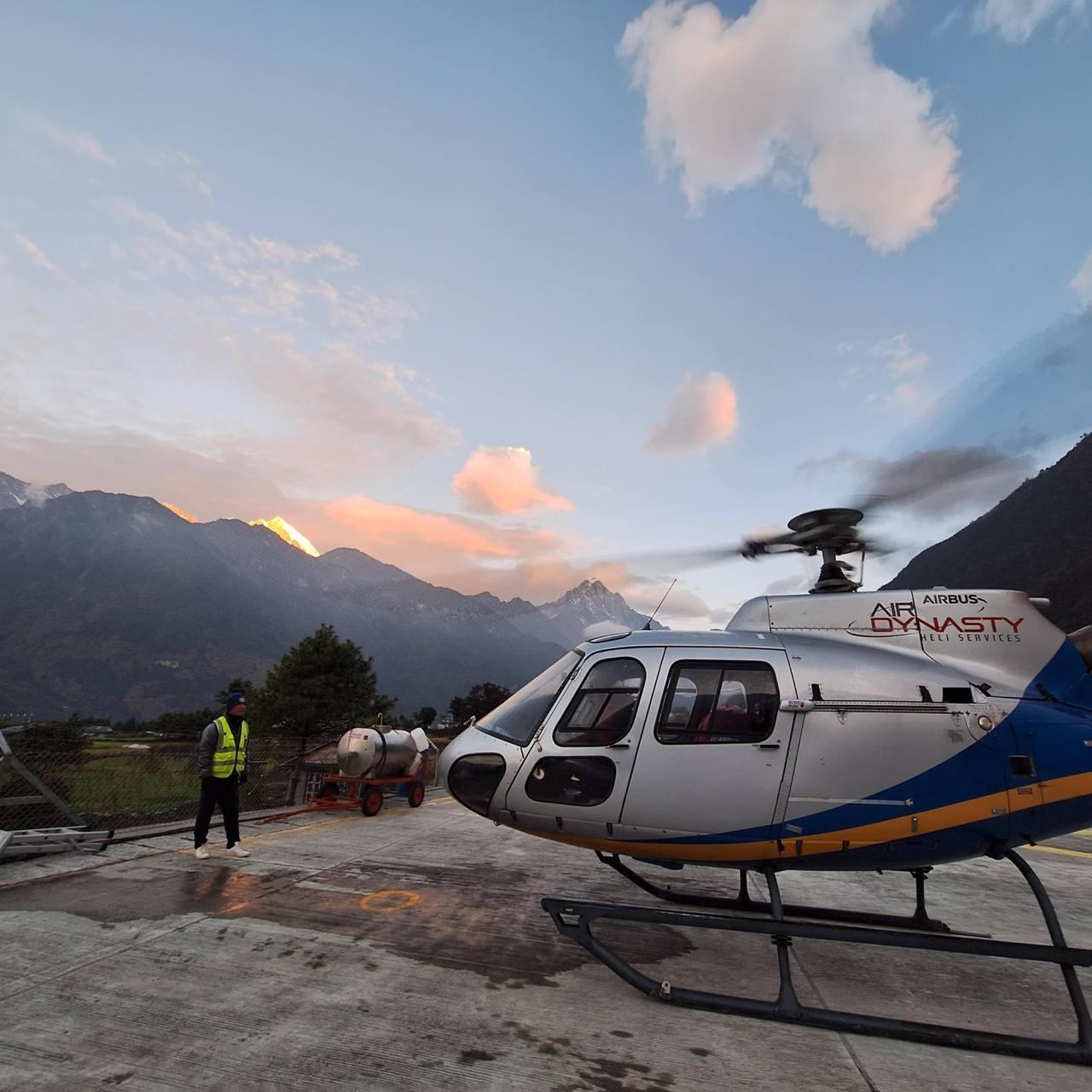
If you are booking a helicopter flight in Nepal, CAAN (the Civil Aviation Authority of Nepal) is the agency in charge of aviation safety, flight approvals, operating rules, and other civil aviation standards. Commercial operators must have a valid Air Operator Certificate (AOC) from the Director General of CAAN, and CAAN's rules cover flight operations, aircraft requirements, safety oversight, aerodromes, and passenger protection.
A helicopter booking is not simply an aircraft reservation. Weather, aircraft availability, operator requirements, flight permissions, landing conditions, passenger weight, and current aviation restrictions can all affect a scheduled flight. Passengers should understand these requirements before paying for a helicopter trip, particularly for high-altitude destinations where weather and operating conditions can change quickly.
This is where Aero Connect Nepal operates at the center of the booking and aviation supply chain. Aero Connect provides direct access to helicopter capacity and manages the commercial and ground-side logistics connecting passengers with operating partners. The company is built around the operational network that makes mountain helicopter travel work, not simply passing a customer's request from one third party to another.
 |  |
|---|
The Civil Aviation Authority of Nepal (CAAN) is Nepal's civil aviation regulator. It was established as an autonomous body in 1998 and oversees aviation safety, along with certain aviation services. For helicopter operations, CAAN regulates air transport services, oversees operators, enforces flight operation requirements, and issues permissions for domestic non-scheduled and charter flights.
CAAN also maintains regulatory requirements covering aircraft operations, flight crew qualifications, training, operational procedures, and safety standards. A commercial helicopter operator cannot conduct commercial air transport without a valid Air Operator Certificate (AOC) issued by the Director General of CAAN.
CAAN's oversight extends beyond the helicopter itself. Its aviation safety structure covers flight safety, aerodrome safety, air transport, aviation security, and other areas of regulatory supervision. CAAN's Aerodrome Safety Standards Department handles certification and safety oversight of aerodromes and also covers permissions for rooftop helipads.
Its Air Transport Department gives permissions for domestic charter and other non-scheduled flights, and can issue restricted-area permissions with the relevant authorities. A legal helicopter operation depends on more than having an available aircraft. The operator, aircraft, flight crew, operating procedures, landing facility, and required permissions must all meet the applicable requirements. Learn about Helicopter Safety Standards in Nepal before booking your flight.
No. CAAN regulates and oversees aviation; it is not the commercial helicopter company carrying passengers on a sightseeing, pilgrimage, rescue, or charter flight. CAAN's current domestic aviation records separately identify Nepal's rotary-wing operators.
The practical structure of helicopter tour is straightforward:
CAAN regulates the aviation system → the licensed helicopter operator conducts the flight → Aero Connect Nepal provides direct commercial access and handles the passenger and ground-side logistics → the passenger travels.
Keeping these roles separate is important. Aero Connect Nepal does not present itself as the helicopter operator, but rather as the commercial aviation business that connects customers with helicopter capacity and the operational support needed for the journey.
A helicopter operator in Nepal must meet CAAN rules for operator certification, aircraft airworthiness, flight crew qualifications, training, operational control, and flight procedures. These rules are especially important for mountain helicopter operations, where altitude, terrain, weather, landing conditions, and aircraft performance can add extra demands. CAAN's helicopter Flight Operations Requirements say that an operator with an Air Operator Certificate must ensure its flight crew is properly qualified, medically fit, licensed, and trained for the duties they perform.
Commercial helicopter operations require the appropriate CAAN-approved operating framework. A holder of an Air Operator Certificate must operate according to applicable CAAN requirements and maintain the systems, personnel, procedures, and operational control necessary for the flights it conducts. CAAN also conducts safety oversight and maintains surveillance and enforcement mechanisms for aviation operators.
The helicopter must be maintained and kept in an airworthy condition before carrying passengers. This includes required maintenance, inspections, technical records, and compliance with applicable airworthiness requirements. CAAN maintains dedicated airworthiness oversight and publishes technical requirements covering aircraft maintenance and continuing airworthiness. A helicopter being available for booking does not mean it can automatically be dispatched. The aircraft must be operationally ready and legally fit for the planned flight.
CAAN requirements go beyond having a pilot in the cockpit. Flight crew must hold the right licences, meet medical requirements, complete required training, and pass the relevant checks to show competence. CAAN's helicopter requirements also include extra qualification standards for high-altitude operations. For example, the published requirements specify additional experience and high-altitude training for pilots operating solo as pilot-in-command at helipads above 10,000 feet, and higher qualification requirements for operations above 17,000 feet.
For our customers, pilot credentials should be stated with actual qualifications, relevant experience, and applicable ratings where those details are available, rather than relying on the vague phrase "experienced pilot."
Before departure, the operator must address the operational conditions affecting the flight. This includes flight planning, weather assessment, fuel requirements, aircraft weight and balance, communications, route and landing considerations, and emergency procedures.
CAAN's requirements also require operators to establish appropriate operational control and emergency duties for flight crew. For passengers, this means a helicopter flight should never be treated as a simple point-to-point transfer. The aircraft, crew, weather, route, landing conditions, and operational permissions must all align before the flight can proceed safely.
Passengers do not need a pilot licence or special aviation qualification to take a commercial helicopter flight in Nepal, but they do have responsibilities before and during the flight. Accurate passenger information, weight disclosure, baggage compliance, identification, and following crew instructions are essential, particularly for mountain flights where aircraft capacity and operating conditions can change.
Passengers can use the checklist given below before their departure:
Passenger weight affects a helicopter's available payload. The operator must account for passengers, baggage, fuel, aircraft weight, altitude, temperature, and the planned flight. At higher elevations, aircraft performance can be more limited, so accurate weight information is especially important.
This matters on Everest Base Camp helicopter tours, Lukla, high-altitude landing sites, Muktinath, and private mountain charters. A booking confirmation does not override aircraft weight and safety limitations. If the final passenger and baggage weight exceeds the aircraft's permitted operating limits, the operator may need to adjust baggage, passenger arrangements, or the flight plan.
Aero Connect Nepal manages passenger and ground logistics before the flight, so weight and booking details can be shared with the operating helicopter company. Providing accurate information when booking helps the team plan the flight and avoid problems at departure.
A helicopter can meet every applicable CAAN requirement and still be unable to depart when weather conditions do not support a safe operation. Nepal's helicopter flight-operation requirements include visual and instrument flight procedures, operating minima, and weather-related operational considerations. CAAN's requirements also specifically address training for conditions such as monsoon operations.
For many mountain helicopter flights, VFR (Visual Flight Rules) is particularly important. Pilots need adequate visual conditions to operate safely under the applicable flight rules. Cloud, reduced visibility, precipitation, wind, and rapidly changing mountain weather can affect whether a flight can depart, continue, land, or return. CAAN compliance therefore does not mean that a booked helicopter is guaranteed to fly regardless of weather. CAAN also maintains procedures for flight permissions, including domestic charter and non-scheduled operations.
Lukla and the Everest region combine mountain terrain, rapidly changing visibility, cloud formation, wind, and high-altitude operating conditions. These factors can change the conditions along a route or at a landing site after a flight has already been scheduled. For passengers, this means a clear forecast at the time of booking is not a permanent guarantee. Check information on Kathmandu to Lukla Helicopter Tour.
The operating team must assess conditions before departure and make the final operational decision based on the conditions and applicable requirements at that time.
A weather cancellation should never become a surprise after you have paid. Read the weather-cancellation and refund policy before booking, and make sure it states exactly what happens when the operator cannot safely operate.
For Aero Connect Nepal, the published policy should specify the refund amount, processing timeframe, and rescheduling options rather than using vague promises such as "easy refund" or "quick refund." Check our refund policy to gain complete information.
Aero Connect's role is to manage the booking and passenger logistics with the operating helicopter company when conditions change. Safety comes before departure, and no booking company should promise that a helicopter will fly when the operating conditions do not permit it.
Continue Reading: Nepal Weather in September & October 2026: What Helicopter Travelers Need to Know
High-altitude helicopter operations require careful attention to aircraft performance, altitude, weather, terrain, landing-site conditions, passenger weight, and ground procedures. As altitude increases, the air becomes thinner, which can reduce helicopter performance and payload capacity. Temperature, wind, terrain, and the landing area must also be considered before and during the operation.
This is particularly relevant in Nepal's mountain destinations. Lukla sits at approximately 2,860 m, Everest View Hotel at about 3,880 m, and Kala Patthar at approximately 5,545 m. These locations should not be treated as interchangeable landing sites. The actual landing location depends on the specific itinerary, aircraft capabilities, weather, applicable permissions, and operational conditions on the day.
At higher elevations, passenger and baggage weight becomes especially important because the helicopter's available payload and performance must remain within operational limits. Weather can also change quickly around mountain landing sites, while uneven terrain, confined landing areas, wind, and reduced visibility can affect the operation.
Check out our Hotel Everest View helicopter tour and learn about a premium experience in the Khumbu region.
A helicopter landing at Everest View Hotel is not the same operation as an EBC helicopter tour with Kala Patthar landing. Your itinerary should clearly state the actual landing point, altitude, and ground time rather than using a generic "Everest landing" description. For Aero Connect Nepal passengers, the specific landing location is determined by the booked itinerary and the operating conditions and permissions applicable to that flight.
Before paying for a helicopter flight in Nepal, check who is arranging your booking, who will operate the helicopter, what is included in the price, how seat availability is secured, what happens if weather prevents departure, and who will support you if the operation changes.
This is where Aero Connect Nepal operates as a premium helicopter booking agency and a major commercial access point for helicopter capacity in Nepal, rather than simply acting as a basic intermediary.
Aero Connect handles booking access, seat availability, passenger support, ground logistics, destination coordination, and communication with operating helicopter companies. Its representatives in Kathmandu, Lukla, Namche, Tengboche, Dingboche, and other Sherpa settlements provide support where passengers actually need it. Within two months of inception,
Aero Connect has served 3,000+ customers and successfully conducted 200+ flights across Nepal. The distinction remains important: Aero Connect Nepal is not the helicopter operator. The flight is conducted by the relevant licensed helicopter operator, while Aero Connect manages the commercial booking and passenger-side logistics around that operation.
This model gives customers a direct booking channel backed by an established operational network, rather than leaving passengers to arrange separate transport, ground support, and flight communication themselves. Before booking, also verify the actual operator, flight duration, landing altitude, ground time, window-seat arrangement, baggage limits, weather policy, refund timeframe, and departure conditions. A professional booking agency should be able to explain these details before taking payment, not after a problem occurs.
Book your Nepal helicopter flight through Aero Connect Nepal and deal with a team that handles the booking, seat availability, passenger support, and ground logistics from Kathmandu to the mountains. Do not choose a helicopter flight based on price alone. Aero Connect gives passengers direct access to helicopter bookings while maintaining representatives in Kathmandu, Lukla, Namche, Tengboche, Dingboche, and other Sherpa settlements to support travelers on the ground.
Within two months of its inception, Aero Connect has served 3,000+ customers and successfully conducted 200+ flights across Nepal. Where weather is clear and the applicable operating conditions are met, our team manages seat availability and booking arrangements according to the terms confirmed for your flight. Don't leave a mountain helicopter booking to an unknown contact or last-minute arrangement. Plan your trip with Aero Connect Nepal today.
The Civil Aviation Authority of Nepal (CAAN) regulates and oversees civil aviation in Nepal. Its responsibilities include aviation safety, operator certification, aircraft airworthiness, flight operations, and applicable aviation permissions.
Yes. Commercial helicopter operators must comply with applicable CAAN requirements covering aircraft, pilots, operations, safety, and certification.
No. CAAN is the regulator, while licensed helicopter operators conduct commercial passenger flights under the applicable aviation rules.
No. Passengers do not need a pilot licence, but they must provide accurate booking information, comply with baggage and weight requirements, and follow crew safety instructions.
Not necessarily. Weather conditions such as poor visibility, clouds, wind, and precipitation can make a flight unsafe even when the operator and aircraft meet CAAN requirements.
VFR means Visual Flight Rules, under which pilots must have sufficient visual conditions to operate safely according to applicable requirements. Mountain weather can quickly affect whether VFR operations are possible.
Everest flights can be affected by visibility, clouds, wind, precipitation, terrain, aircraft performance, landing conditions, or applicable operational restrictions. A confirmed booking does not override these safety requirements.
Yes. Passenger and baggage weight directly affect available payload and aircraft performance. This becomes especially important at high-altitude destinations such as Everest and other mountain landing sites.
Yes. Helicopters have limited payload capacity, so passengers must comply with the applicable baggage allowance. Excess baggage may need to be left behind or handled separately.
Yes. Pilots must hold the appropriate licences, ratings, medical certification, training, and qualifications for their duties and the operation they conduct.
Yes. High-altitude operations can require additional pilot experience, training, and operational considerations. Aircraft performance and landing conditions must also be assessed.
No. A booking does not override weather, safety, aircraft, or regulatory restrictions. The flight can only proceed when the operating conditions permit it.
The actual flight is conducted by the relevant licensed helicopter operator. Aero Connect Nepal is a premium helicopter booking and logistics agency, not the helicopter operator.
Aero Connect provides direct helicopter booking access, seat availability management, passenger support, ground logistics, destination representatives, and operational coordination across Nepal.
Check the actual operator, flight duration, landing altitude, ground time, baggage allowance, seat arrangement, weather-cancellation policy, refund timeframe, and passenger support. These details should be clear before you make payment.