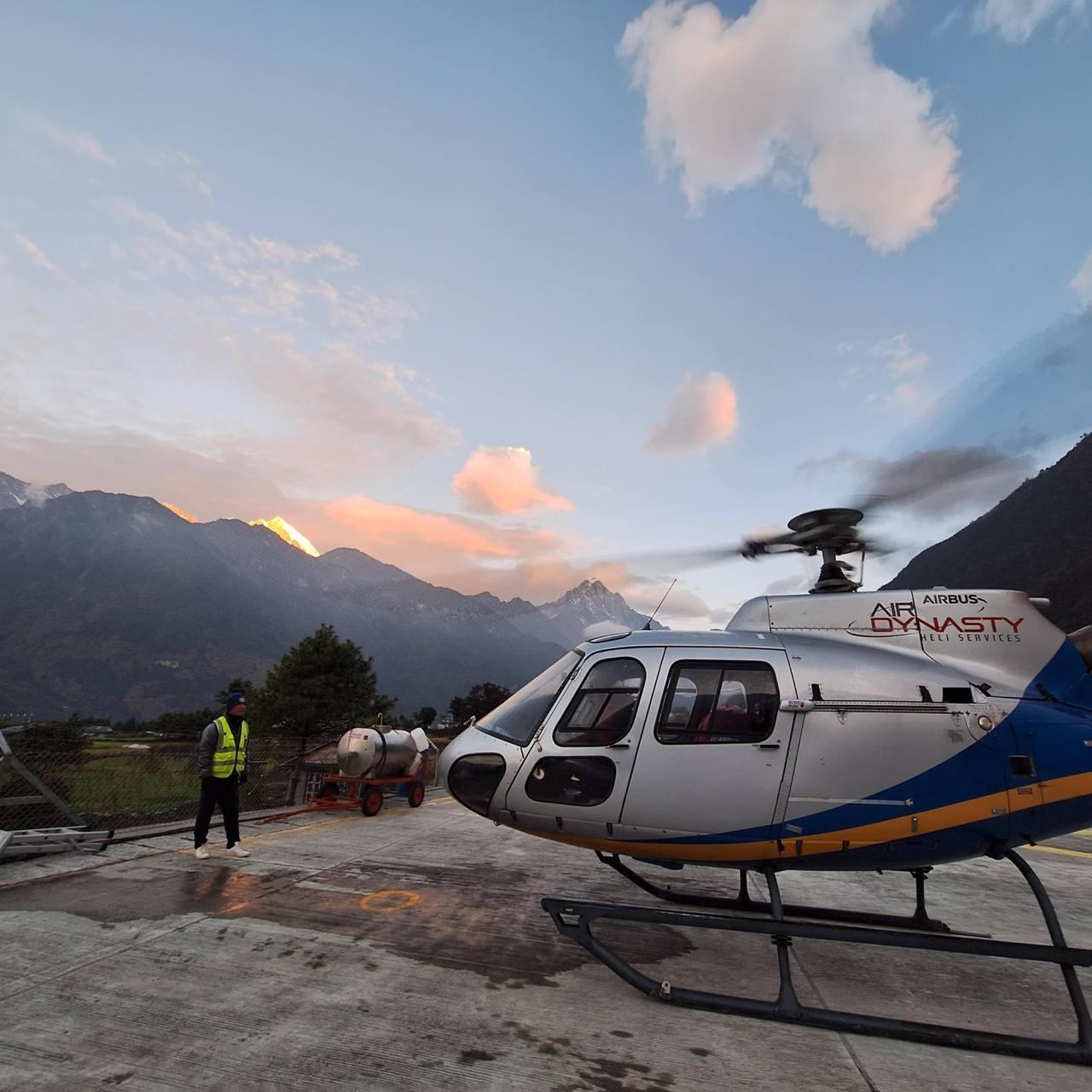
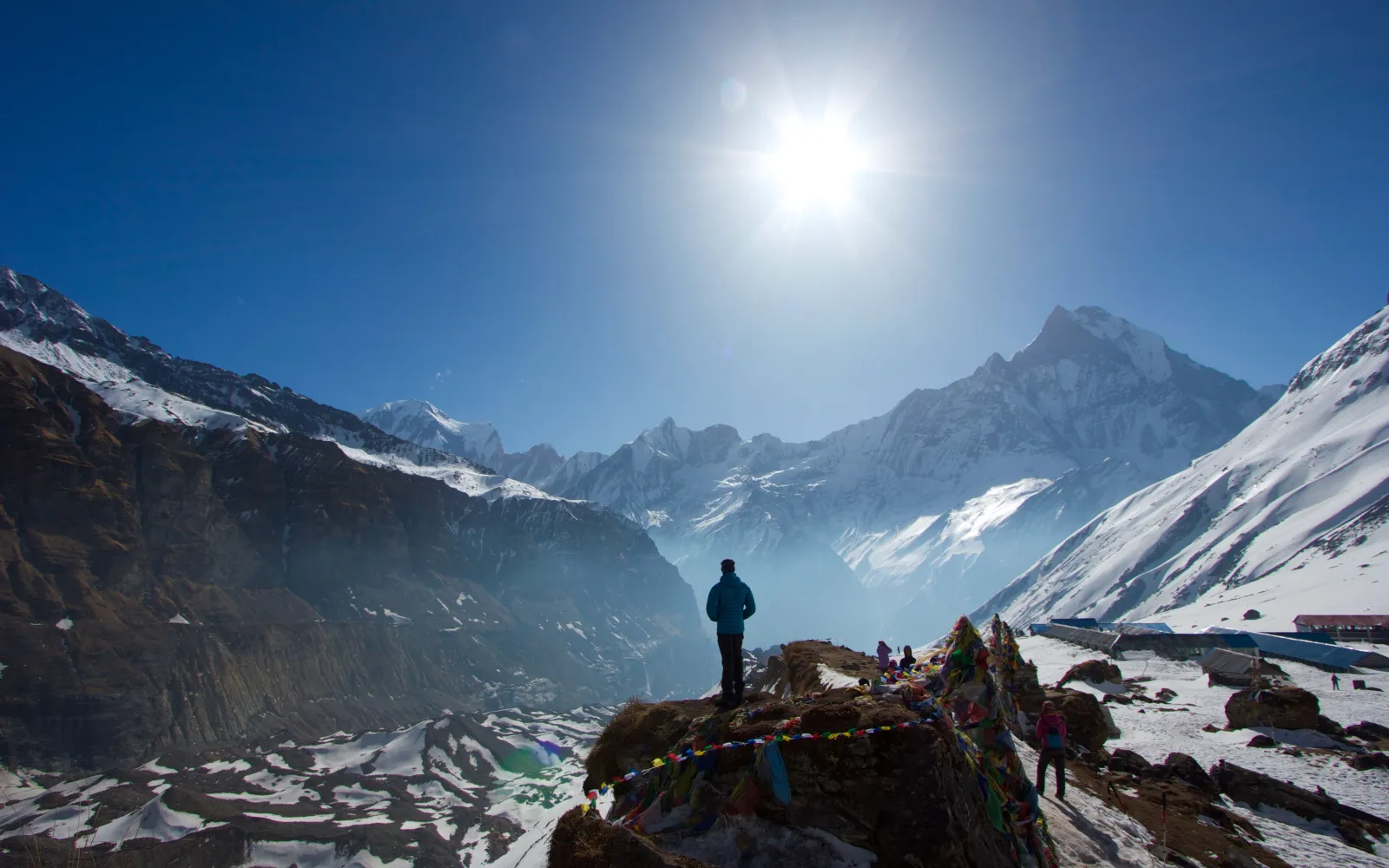
September and October mark one of the most important weather transitions in Nepal. September is still influenced by the southwest monsoon, while October normally moves Nepal toward the drier post-monsoon period.
For helicopter travelers, however, the change is not simply a matter of one date on the calendar. Weather can vary considerably between Kathmandu, Pokhara, Lukla, Namche, the Everest region, Annapurna and Mustang because elevation and mountain terrain strongly influence cloud, rainfall, visibility and wind.
Nepal's Department of Hydrology and Meteorology (DHM) defines 2 October as the normal monsoon withdrawal date, but recent years demonstrate that the actual withdrawal can occur later. In 2025, for example, DHM reported that the monsoon withdrew from eastern Nepal on 10 October, eight days later than normal.
This makes September and early October a transition period rather than a guaranteed boundary between "monsoon weather" and "clear weather."
For travelers planning helicopter tours, the most useful approach is therefore to combine:
The table below combines long-term climate information with current 2026 forecast information where available. The WeatherSpark figures are climatological patterns, not guaranteed September or October 2026 measurements. AccuWeather figures represent the currently available 2026 forecast period.
| Location / Metric | September | October |
|---|---|---|
| Kathmandu typical daytime temperature | Around 27°C | Around 27°C → 24°C |
| Kathmandu typical nighttime temperature | Around 20°C → 17°C | Around 17°C → 11°C |
| Kathmandu wet-day probability | ~55% → 28% | ~27% → 4% |
| Kathmandu sliding 31-day rainfall | ~137 → 64 mm | ~61 → 13 mm |
| Pokhara daytime temperature | ~28°C → 27°C | ~27°C → 24°C |
| Pokhara nighttime temperature | ~22°C → 19°C | ~19°C → 14°C |
| Pokhara wet-day probability | ~50% → 26% | ~25% → 5% |
| Pokhara average wind | ~7.1 km/h | ~6.8 km/h |
WeatherSpark defines a "wet day" as a day with at least 0.04 inches, or approximately 1 mm, of precipitation. Its Kathmandu September data shows the probability of a wet day declining from about 55% at the beginning of the month to 28% by the end.
For October, the same long-term dataset shows Kathmandu's wet-day probability falling from approximately 27% at the beginning of the month to just 4% by the end. The associated sliding 31-day rainfall indicator falls from about 2.4 inches (61 mm) to 0.5 inches (13 mm).
These numbers should be interpreted as typical climate behavior, not as a prediction that every day in 2026 will follow the same pattern.
September is a transition month. Rainfall generally decreases as the month progresses, but the atmosphere can still support significant cloud development, showers and localized weather systems.
DHM considers June through September the normal monsoon season and places the climatological withdrawal date at 2 October. However, the actual withdrawal date varies from year to year.
In Kathmandu, long-term September temperatures remain relatively warm. WeatherSpark places typical daily highs around 27°C, with daily lows declining from approximately 20°C to 17°C through the month.
The more important change for helicopter operations is precipitation.
WeatherSpark's Kathmandu climatology shows the average sliding 31-day rainfall decreasing from approximately 5.4 inches (137 mm) at the beginning of September to around 2.5 inches (64 mm) toward the end.
Pokhara generally remains wetter than Kathmandu. WeatherSpark shows September daytime temperatures declining from approximately 28°C to 27°C, while nighttime temperatures decrease from roughly 22°C to 19°C. The probability of a wet day falls from approximately 50% to 26% through September.
The cloud trend is also important. In Pokhara, WeatherSpark's long-term data shows the proportion of time with overcast or mostly cloudy conditions falling substantially during September, from about 68% at the beginning of the month to 27% near the end.
This helps explain why a helicopter trip can have very different operating conditions on 5 September and 25 September even though both dates technically fall within the same month.
For helicopter operations, rainfall itself is only one part of the equation.
Pilots and operators are concerned with the combined effect of:
A clear morning in Kathmandu does not automatically mean that the Everest or Annapurna corridor is clear.
Mountain weather can develop locally as moist air interacts with steep terrain. This is particularly important in September when monsoon moisture has not completely disappeared.
For travelers, this means that a departure may sometimes be delayed until the mountain route becomes sufficiently clear rather than simply being based on the weather over Kathmandu.
October normally represents the transition toward Nepal's post-monsoon period.
The timing is important. The normal monsoon withdrawal date is 2 October, but DHM records show that actual withdrawal can occur later. In 2025, withdrawal from eastern Nepal occurred on 10 October.
Therefore, early October should not automatically be treated as completely dry, particularly in eastern and central mountain regions.
By the middle and latter part of October, however, long-term climate data generally shows a substantial reduction in rainfall and cloud cover.
Temperature changes dramatically with elevation.
The Nepal Tourism Board states that average temperature decreases by approximately 6°C for every 1,000 metres of elevation gain. It also notes that about 80% of Nepal's precipitation occurs during the June–September monsoon period.
This means that Kathmandu's temperature cannot be used as a direct representation of conditions around Everest Base Camp, Kala Patthar or other high-altitude destinations.
For example, Kathmandu can remain relatively warm while temperatures at high-altitude landing locations are close to freezing, particularly during early morning operations.
October also produces a significant change in Pokhara. WeatherSpark's long-term data shows Pokhara's typical daytime temperature decreasing from approximately 27°C to 24°C through October, while nighttime temperatures decline from approximately 19°C to 14°C.
The probability of a wet day also falls from roughly 25% at the beginning of October to 5% at the end, while the sliding 31-day rainfall indicator falls from about 2.8 inches (71 mm) to 0.6 inches (15 mm).
Pokhara's cloud cover also decreases significantly during October. WeatherSpark reports overcast or mostly cloudy conditions falling from around 26% of the time at the start of the month to about 8% by the end.
Temperature and altitude are not simply passenger-comfort considerations. They also affect helicopter performance.
For an Airbus H125, Airbus lists:
These are Airbus-published technical specifications.
A crucial distinction is that the 7,010 m maximum flight altitude is not the same thing as the aircraft's hover capability at maximum takeoff weight.
Hover performance is affected by density altitude, temperature, aircraft weight and other operational conditions. Airbus specifically publishes a lower HOGE figure at MTOW than its maximum flight altitude.
For high-altitude helicopter tourism, this is one reason passenger loads, fuel requirements, weather and operating conditions must be assessed together rather than using a single altitude number.
Nepal's geography makes regional weather differences particularly important for helicopter travel.
The Nepal Tourism Board notes that the Himalayas influence the country's rainfall patterns and that areas such as Manang and Mustang lie in the rain shadow of the mountains.
A Kathmandu forecast provides useful information about departure conditions, but it does not establish the weather along the entire route to the Everest region.
The helicopter corridor can pass through multiple elevation zones, each with different cloud, wind and visibility conditions.
For an Everest Base Camp or Kala Patthar flight, relevant conditions include:
This is why a clear-looking Kathmandu morning can still result in a delay for a high-altitude helicopter flight.
Travelers planning an Everest helicopter experience can explore the Everest Base Camp Helicopter Tour with Kala Patthar, where conditions at the high-altitude destination are particularly important.
For travelers who want an aerial Everest experience without the same landing requirements, an Everest Base Camp Helicopter Overfly Tour is another route option.
Pokhara and the Annapurna region experience substantially different rainfall patterns from Nepal's rain-shadow areas.
The Nepal Tourism Board identifies Pokhara as one of Nepal's wetter locations and notes the major contrast between high-rainfall areas and rain-shadow regions such as Mustang.
WeatherSpark's September data also shows that Pokhara remains wetter early in the month, with wet-day probability declining from approximately 50% to 26%.
By October, that probability decreases from roughly 25% to 5%.
This seasonal change is one reason October generally provides a different operating environment from early September, although individual flight conditions must still be assessed on the day.
Mustang sits behind the main Himalayan ranges and is strongly influenced by the rain-shadow effect.
The Nepal Tourism Board identifies Mustang and Manang as rain-shadow areas and reports that Mustang receives substantially less annual precipitation than wetter parts of Nepal.
This does not mean Mustang is automatically free from wind or cloud. Mountain terrain can still produce localized conditions, and conditions along the flight route can differ from those at the destination.
For travelers visiting Muktinath, the Muktinath Helicopter Tour is one example where regional weather differences between the central mountains and Mustang become particularly relevant.
A helicopter flight is not approved simply because a weather application shows sunshine at the departure airport.
Weather assessment is route-specific and considers the conditions relevant to the aircraft, route, destination and operation.
The Civil Aviation Authority of Nepal (CAAN) publishes aeronautical information through its official e-AIP system. The current e-AIP structure includes both GEN 3.5 Meteorological Services and ENR 1.2 Visual Flight Rules.
The published CAAN ENR 1.2 document specifies visibility and cloud-clearance requirements for VFR operations and states that VFR flights must be conducted with visibility and distance from cloud meeting the applicable requirements. The document also states that VFR operations within a control zone are subject to ceiling and ground-visibility conditions unless appropriate clearance is obtained.
Because the detailed ENR 1.2 document cited here is an older AIP edition, travelers should not treat the figures in that document as a substitute for checking the current CAAN e-AIP requirements. The current CAAN e-AIP should be used for applicable operational information.
Before a mountain helicopter flight, weather assessment can involve several different pieces of information rather than a single forecast number.
These can include:
This is particularly important in September because a forecast can improve significantly over the course of a morning, while mountain cloud can also build quickly.
Kathmandu, Lukla, Namche and high-altitude destinations do not share the same microclimate.
A weather forecast for Tribhuvan International Airport is therefore useful for understanding the departure environment, but it cannot by itself establish conditions at Kala Patthar, Everest Base Camp or another high-altitude location.
This distinction becomes particularly important when using consumer weather applications.
Nepal's Department of Hydrology and Meteorology is the country's government meteorological authority and provides weather observations, forecasts, climate information and monsoon-related information.
DHM's monsoon information identifies 13 June as the normal monsoon onset date and 2 October as the normal withdrawal date. Its 2025 seasonal summary also recorded withdrawal from eastern Nepal on 10 October, demonstrating why the normal date should not be interpreted as a fixed annual switch.
The Civil Aviation Authority of Nepal provides Nepal's aeronautical information publications, including meteorological services and visual flight rules.
For helicopter travelers, CAAN's information is particularly relevant because weather decisions are ultimately connected to aviation requirements, not simply tourism forecasts.
WeatherSpark is useful for understanding the typical seasonal progression rather than predicting a specific helicopter flight.
For example, its Kathmandu data shows wet-day probability decreasing substantially from September into October, while Pokhara shows a similar but wetter seasonal pattern.
WeatherSpark also explicitly notes that its Pokhara climate analysis is based on historical weather reports and model/reanalysis data rather than a real-time mountain aviation forecast.
WeatherSpark — Kathmandu Climate Data
WeatherSpark — Kathmandu September Weather
WeatherSpark — Kathmandu October Weather
WeatherSpark — Pokhara September Weather
WeatherSpark — Pokhara October Weather
AccuWeather provides current 2026 forecast information for locations such as Tribhuvan International Airport.
As of the current September 2026 forecast, AccuWeather's displayed September data shows daily highs ranging from approximately 68°F to 85°F (20°C to 29°C) and lows between approximately 59°F and 66°F (15°C and 19°C) over the displayed period.
These numbers should be treated as forecast information for the currently available period, not as a guaranteed prediction for the entire month.
A detailed daily forecast for late October cannot be treated as reliable this far in advance. For October planning, long-term climatology is more appropriate until the relevant short-range forecast window becomes available.
AccuWeather — Tribhuvan International Airport September 2026
For aircraft-performance information, Airbus publishes the H125's technical specifications, including its certified hover ceiling, maximum flight altitude, MTOW, useful load and cruise performance.
These specifications provide aircraft-performance context, but actual helicopter operations depend on the specific aircraft configuration, weight, temperature, altitude, fuel requirements and operating conditions.
Airbus H125 Technical Information
If you are planning a helicopter trip in September 2026, expect the possibility of continued monsoon influence, particularly during the earlier part of the month. Rainfall and cloud cover generally decrease toward the end of September, but conditions remain variable. WeatherSpark's long-term data supports this declining precipitation trend, while DHM's monsoon framework confirms that the normal withdrawal date is not until 2 October.
For October 2026, the long-term climate pattern generally becomes progressively drier, with lower rainfall probabilities and decreasing cloud cover. However, early October can still experience residual monsoon influence, and DHM's recent observations demonstrate that monsoon withdrawal can occur later than the climatological date.
For helicopter travelers, the most useful principle is therefore simple:
Plan around the weather trend but make the final flight decision around the actual weather conditions on the route and at the destination.
A clear forecast in Kathmandu is encouraging, but mountain visibility, cloud, wind and landing conditions still need to be suitable for the planned operation.
For travelers looking for a lower-altitude mountain-view experience, Aero Connect Nepal also offers the Hotel Everest View Helicopter Tour and Kongde Helicopter Tour with Breakfast, where route and destination conditions remain important, but the operating profile differs from a high-altitude Kala Patthar landing.
Ultimately, September and October can offer very different flying environments in Nepal. September remains a transition month with meaningful monsoon influence, while October generally moves toward drier and clearer conditions. The exact flight window, however, is determined by real-time aviation weather and operational assessment, not by the calendar alone.
September is a transition month between the southwest monsoon and the drier post-monsoon period. Rainfall and cloud cover generally decrease as the month progresses, but monsoon conditions can still affect Kathmandu, Pokhara and Himalayan flight routes. Nepal's Department of Hydrology and Meteorology (DHM) gives 2 October as the normal monsoon withdrawal date, although the actual withdrawal varies from year to year.
October generally brings a shift toward drier conditions and clearer skies compared with the monsoon months. However, weather conditions can still vary by location and altitude, particularly during early October. Helicopter flights remain dependent on the actual weather conditions along the route and at the destination.
Not necessarily. 2 October is the climatological normal withdrawal date, not a guaranteed annual end date. DHM reported that the monsoon withdrew from eastern Nepal on 10 October in 2025, demonstrating that the transition can occur later than the normal date.
September can still be relatively wet in Kathmandu, particularly during the first part of the month. Long-term WeatherSpark data shows the probability of a wet day decreasing from approximately 55% at the beginning of September to 28% near the end of the month.
Generally, yes. Long-term climate data shows a substantial decrease in precipitation from September to October. In Kathmandu, WeatherSpark's data shows wet-day probability declining from approximately 27% at the beginning of October to around 4% by the end of the month.
HOGE means Hover Out of Ground Effect. It describes the helicopter's ability to hover without benefiting from the aerodynamic effect of the ground. Airbus publishes an H125 HOGE performance figure of 3,871 m at MTOW under ISA conditions.
HIGE means Hover In Ground Effect. It refers to hovering close enough to the ground to receive the aerodynamic benefit known as ground effect. Airbus publishes an H125 HIGE figure of 4,420 m at MTOW under ISA conditions.
Long-term climate patterns generally show decreasing cloud cover and precipitation through October compared with September. However, conditions vary by region and altitude, so clearer seasonal conditions do not guarantee clear weather on every flight date.
Flight operations depend on the specific weather conditions, route, visibility, cloud, aircraft and applicable aviation requirements. Light rain alone does not provide enough information to determine whether a particular helicopter flight can operate safely.
Yes. Mountain weather can differ significantly from conditions in Kathmandu. A helicopter may have suitable departure weather in Kathmandu while cloud, visibility, wind or other conditions along the Himalayan route make the planned operation unsuitable.