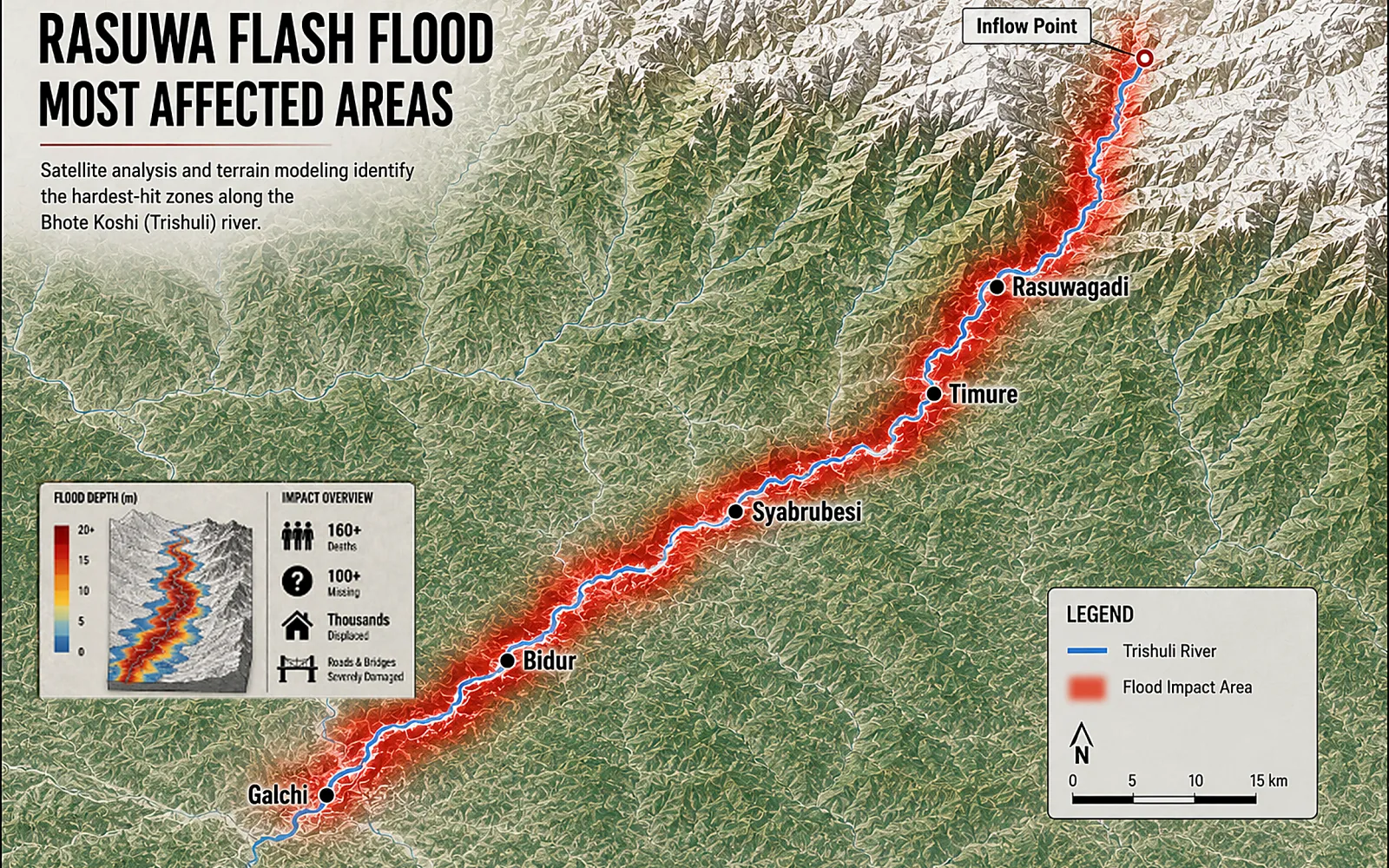
This article is an aviation-specific follow-up to our earlier report, “Massive Flash Flood from Tibet Devastates Rasuwagadhi Border,” which provides the full timeline of the Rasuwa flood. The focus here is on what the disaster means for helicopter operations, damaged helipad infrastructure, emergency rescue flights, CAAN permissions, pilot requirements, and the possible suspension or disruption of trekking and tour packages in affected areas. As of August 27, 2026, 8:32 AM Nepal time, the situation remains active, and operational conditions can change quickly.
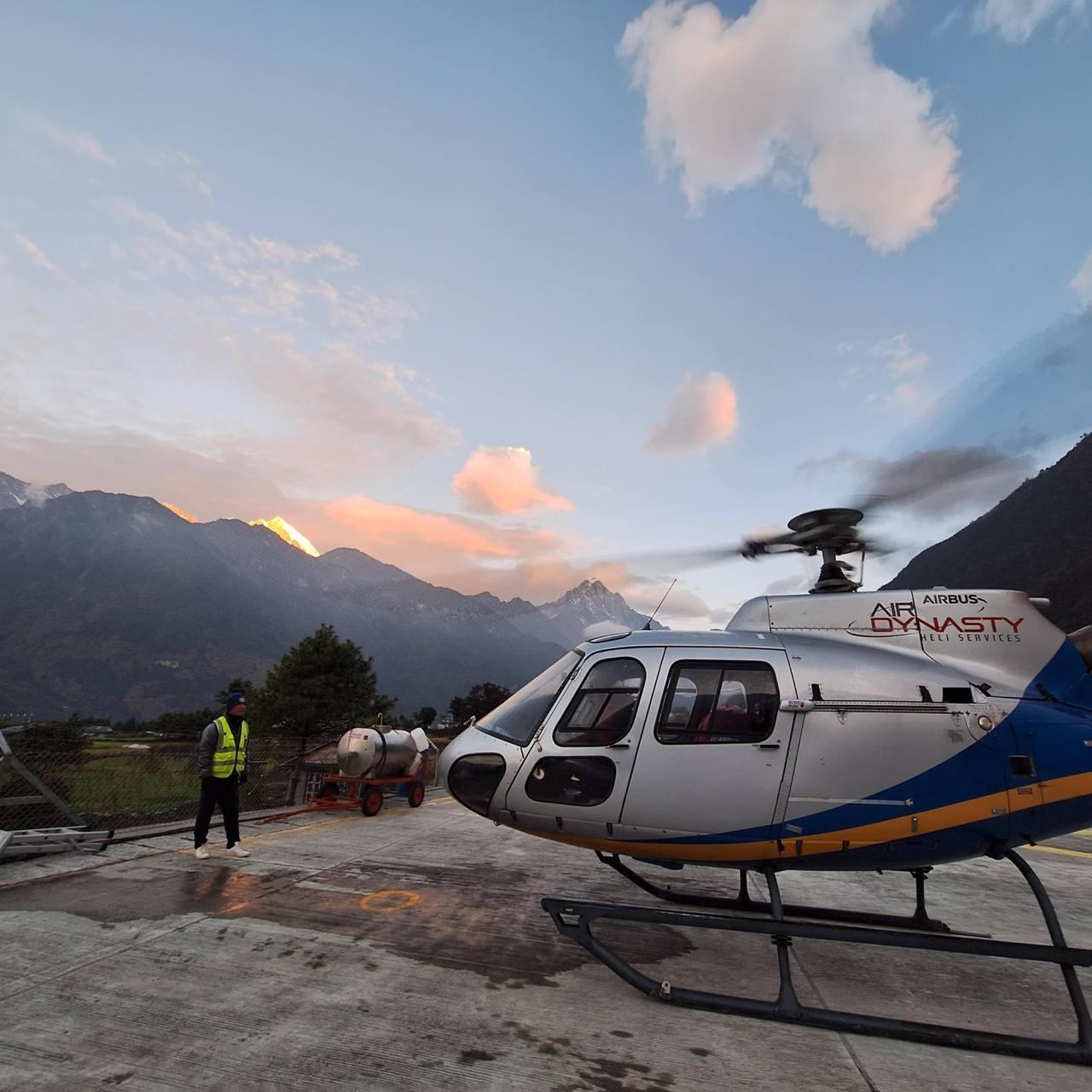
The flood has already demonstrated that having an aircraft available does not automatically mean a flight can operate. In Timure, for example, a rescue helicopter was unable to land after floodwaters swept away the local helipad. Weather, safe landing areas, aviation permissions, pilot requirements, fuel logistics, and the condition of routes and infrastructure can all affect whether a flight is actually feasible.
Confirmed reporting shows that the Timure local helipad was swept away by floodwaters on August 26, 2026. An Altitude Air helicopter sent to rescue stranded people returned to Kathmandu because the pilot could not find a safe place to land after the helipad was lost. The report specifically identifies Timure, but current sources do not provide sufficient confirmation to state that the Syabrubesi helipad or other named landing areas were destroyed.
A usable helipad provides a controlled location for helicopters to land, take off, load passengers, and coordinate ground assistance. When that facility is swept away or surrounded by flood debris, even an aircraft capable of reaching the affected area may have nowhere safe to land. This can complicate emergency evacuation, medical transfers, movement of stranded passengers, and the positioning of rescue crews and equipment. The Timure incident demonstrates this directly, as the rescue helicopter had to return without landing because no safe landing area was available.
The aviation challenge also extends beyond the landing area. Flood damage to roads, bridges, power lines, communications systems, and nearby infrastructure can make it difficult for ground teams to reach landing sites, move fuel and equipment, or coordinate passenger transfers. Reports confirm extensive damage to roads, bridges, settlements, and hydropower infrastructure around Timure and Syabrubesi.
The key point is that helicopter capability alone does not determine whether a flight is possible. A safe landing area, ground access, communications, fuel arrangements, weather, and operational conditions all need to be considered.
Emergency helicopter operations in the Rasuwa flood-affected area depend on several conditions being suitable at the same time. Pilots must assess visibility, cloud cover, rain, wind, route conditions, and the availability of a safe landing area before operating. Aircraft availability and pilot judgment also matter, particularly when flying close to damaged infrastructure and difficult mountain terrain. On August 26, an Altitude Air helicopter sent to Timure had to return to Kathmandu because the flood had swept away the local helipad, and the pilot could not identify a safe place to land.
Current reporting confirms that helicopters are operating for emergency rescue and relief work in affected areas. Nepal Army and private helicopters have been deployed to areas including Timure, Syafrubesi, Dhunche, Trishuli, Mailung, and Dhading, with rescue flights transporting injured people and others to safety. However, this should not be interpreted as confirmation that every landing site or route in the wider Rasuwa and Langtang region is operational. Timure, in particular, has had a confirmed landing-area problem, while the status of other specific civilian landing sites requires current confirmation.
Flood damage to roads, bridges, power systems, and other infrastructure can complicate helicopter operations even when an aircraft is available. Fuel, medical equipment, ground crews, communications, and passenger transfers all require coordination, while aircraft may need careful positioning and turnaround planning. Current reporting confirms extensive damage to roads and bridges in the affected region, making ground support more difficult.
Monsoon weather can change quickly in the mountains, creating short periods when visibility, cloud, wind, and rainfall are suitable for flight. Rescue planners, therefore, have to work around changing weather and damaged infrastructure. A helicopter may technically be capable of reaching an area, but the flight can still be delayed until the pilot identifies a safe operating window and suitable landing conditions. For travelers monitoring conditions elsewhere in Nepal, check the latest Nepal weather update before making flight plans.
For current commercial flight feasibility, travelers should confirm the latest route, landing-site status, weather, and aircraft availability directly with the operator before departure.
The Civil Aviation Authority of Nepal (CAAN) remains in charge of aviation regulation and operational oversight during emergency helicopter activity. In emergencies, aviation authorities, government agencies, security forces, and helicopter operators may need to coordinate quickly, but regulatory oversight does not replace the pilot's responsibility to decide whether a flight and landing can be conducted safely. During the Rasuwa response, the government placed available helicopters on standby and mobilized the Nepal Army and private-sector aircraft for search, rescue, and relief operations.
Current reporting says the government has activated helicopter resources for emergency rescue and relief, and has directed private helicopter companies to stay ready. The National Disaster Risk Reduction and Management Authority also asked helicopter operators and related groups to coordinate with district administrations, security agencies, and local authorities for search and rescue. These steps should not be described as a blanket waiver of normal aviation permissions or safety requirements.
Emergency status does not mean helicopters can operate without the right authorization, suitable aircraft, qualified crews, or safe conditions. Authorities have also restricted movement on several roads in affected areas because of flood and landslide risks, showing that access and infrastructure conditions still matter.
A government authorization is only one part of the decision. Weather, visibility, aircraft availability, pilot judgment, route conditions, landing-site suitability, fuel, and ground coordination still determine whether a sortie can actually happen. Timure shows this clearly: a rescue helicopter reached the area but reportedly turned back because the flood had washed away the local helipad and the pilot could not find a safe place to land.
The Rasuwa flood has disrupted access to the Langtang Valley and Tamang Heritage Trail, but I would avoid stating that every package has been formally suspended unless the specific operator or authority has confirmed it. The confirmed situation as of August 27, 2026, is that flooding damaged the road to Syabrubesi, the main gateway for Langtang trekking, and authorities have advised against travel in affected areas. New Zealand's official travel advisory also says travelers should avoid the Galchhi-Nuwakot-Rasuwa-Syabrubesi road and not enter flood-affected areas.
A trekking package depends on more than the trail itself. Langtang and Tamang Heritage itineraries depend on road access to Syabrubesi, accommodation and local services, functioning bridges, communication networks, and emergency assistance. The flood damaged roads, bridges, settlements, and other infrastructure around Rasuwa, causing access problems even where the trekking trails themselves may not have been directly damaged. Current reporting says the Langtang Valley Trail is still being assessed, so it is too early to say the entire trekking region is destroyed or permanently closed.
Travelers with upcoming Langtang or Tamang Heritage bookings should contact their trekking agency before traveling toward Rasuwa. Depending on the access route and the agency's policy, they may be able to change the departure date, postpone the trek, adjust the itinerary, or discuss cancellation and refund options. No refund should be assumed unless it is confirmed in the booking terms. If travel plans are affected, agencies should provide the latest information on access, accommodation, transportation, and whether the planned itinerary can safely operate.
Under Nepal's 2026 Monsoon Circular, CAAN requires helicopter flights during the monsoon to have two pilots, known as dual-pilot operations. The circular took effect on June 15, 2026, and applies during the monsoon period, with an exception for medical evacuation flights carrying stretcher patients. This requirement is part of CAAN's broader monsoon safety measures, which include weather checks, identifying alternative landing areas, and checking aircraft systems.
On August 26, 2026, during the Rasuwa flood response, reports said a temporary relaxation allowed a helicopter to operate with one pilot for rescue work. Kantipur reported this in connection with helicopter and rescue deployments to Rasuwa, but the available reporting does not clearly state the full written order, its duration, geographic scope, or aircraft categories. Separately, the Prime Minister's Office told private helicopter operators to carry out flood-rescue flights without prior government approval.
The reported relaxation was an emergency measure to allow more helicopters to be used for search, rescue, and relief work when extra aviation capacity was urgently needed. Authorities had put private and government helicopters on standby, and the National Disaster Risk Reduction and Management Authority asked operators to coordinate with district administrations and security agencies.
The temporary measure does not mean every helicopter can fly with one pilot, or that normal safety rules have been removed. Weather, visibility, aircraft condition, pilot qualifications, route conditions, landing-site suitability, and operational judgment still apply, and the three reported helicopters carrying rescue supplies had to return to Kathmandu because of poor weather.
Because the exact scope and duration of the one-pilot emergency exemption have not been clearly published, it is safer to describe it as a reported temporary emergency relaxation for rescue operations rather than a blanket change to Nepal's monsoon helicopter rules.
Authorities are monitoring the upstream water situation and the dammed lake formed after the landslide and debris event near the Nepal-Tibet border. Chinese authorities are also watching the lake and checking for further changes, but there is no verified basis to say a breach is imminent.
Changing water levels can affect aviation by damaging or blocking roads, bridges, landing areas, and access routes used by rescue teams. Even after the flood has passed, debris and shifts along river corridors can change where helicopters can safely land and where ground crews can work. For rescue planning, pilots and authorities need up-to-date information on river conditions, weather, landing-site safety, and access to affected communities. The disaster has already damaged major infrastructure along the Bhote Koshi and downstream corridors, making rescue and relief operations harder.
Recent landslide incidents in the Tatopani area show why infrastructure should be reassessed after slope failures. A landslide damaged structures near the Armed Police Force post at Tatopani Customs on August 7, showing that access and facilities can remain vulnerable after the initial event. For aviation planning, the key issue is distinguishing confirmed conditions from possible hazards. Before any rescue, charter, or passenger flight is planned, check water levels, landing-site status, weather, and official instructions.
The government has deployed the Nepal Army and private helicopters for search, rescue, medical evacuation, and relief work in the flood-hit districts. On August 27, the National Disaster Risk Reduction and Management Authority (NDRRMA) told district authorities to make sure private helicopters involved in rescue work operate under government coordination, while Nepal Army helicopters continued evacuating people from areas including Timure and Syafru.
Private helicopter operators were asked to support the emergency response. At first, private helicopters could carry out rescue flights without prior government approval. That rule has since been tightened, and authorities now require operators to coordinate rescue flights through the relevant government agencies because of concerns about air traffic congestion and operational risks.
For travelers, these announcements mean helicopter availability in the affected region is being directed mainly toward emergency response, not normal tourism. Even if multiple aircraft are present, a passenger or charter flight may still not operate because government coordination, airspace management, weather, aircraft availability, landing conditions, and route safety must all be considered. Current travelers should contact their operator for the latest flight status and charter availability before making arrangements.
Travelers with upcoming trips to Rasuwa, Langtang, or nearby mountain areas should expect possible changes to flight and trekking plans. Flood damage, weather, access conditions, and the ongoing emergency response may affect both tourism flights and ground itineraries.
Do not assume that a previously confirmed helicopter flight will operate on its original date or route. Conditions can change quickly, so verify the latest flight status, landing arrangements, and route accessibility directly with your operator before traveling to the departure point.
Your trekking or travel agency should confirm the current route status, helicopter availability, accommodation, and any changes to the itinerary. Ask whether they can reschedule or offer an alternative route if access is still disrupted, and check the agency's terms before deciding about cancellations or refunds. If your flight is delayed or grounded, see What to Do When Your Mountain Flight Is Grounded for practical alternatives.
Emergency helicopter availability depends on aircraft location, weather, aviation permissions, route conditions, suitable landing areas, and passenger needs. The presence of helicopters in the region does not guarantee immediate rescue or charter availability, especially while aircraft and crews are being used for disaster-response operations.
Allow extra days in your itinerary and avoid tight connections on international flights while conditions remain uncertain. Keep your phone and other communication channels active so your operator or agency can send updated instructions.
For the latest flight information or charter coordination, contact Aero Connect Nepal before you make travel arrangements.
1. Rasuwa: 9851277777 (CDO), 9851164422 (Ast. CDO), 9851282801 (Nepal Police), 9851272275 (APF)
2. Nuwakot: 9851147777 (CDO), 9851248777 (Ast. CDO), 9851282811 (Nepal Police), 9851272535 (APF)
3. Dhading: 9851247777 (CDO), 9851196131 (Ast. CDO), 9851113921 (Nepal Police), 9851272491 (APF)
4. Chitwan: 9855017777 (CDO), 9855088891 (Ast. CDO), 9855090133 (Nepal Police), 9851272134 (APF)
5. Gorkha: 9856057777 (CDO), 9856057778 (Ast. CDO), 9856090255 (Nepal Police), 9851272271 (APF)
6. Tanahun: 9856067777 (CDO), 9856001111 (Ast. CDO), 9856090178 (Nepal Police), 9851272099 (APF)
7. 1234 (DEOC)
The Rasuwa flood has created significant challenges for helicopter operations, from damaged landing infrastructure and disrupted access routes to changing flight feasibility and increased demand for emergency aviation. Government coordination, emergency permissions, temporary regulatory measures, trekking package suspensions, and pilot decision-making are all affecting how flights can be conducted. Having a helicopter available does not automatically mean that a flight can operate.
Weather, visibility, route conditions, aircraft performance, regulatory permissions, suitable landing areas, fuel logistics, and pilot judgment must still be assessed for each flight. The situation remains developing, so operational information can change as authorities assess infrastructure and weather conditions. Travelers with existing bookings should stay in direct contact with their trekking or travel agency and confirm the latest arrangements before departure. For updated flight status or charter coordination, where applicable, contact Aero Connect Nepal for current operational information.
Yes, helicopter search, rescue, and relief operations are ongoing, with the Nepal Army and private aircraft involved under government coordination. Actual flights depend on weather, aircraft availability, permissions, route conditions, pilot judgment, and safe landing areas.
There is no blanket confirmation that the entire Langtang region is either open or closed to helicopter operations. Access must be assessed for the specific destination based on current weather, route conditions, aircraft availability, permissions, and landing-site suitability.
The Timure helipad was confirmed to have been swept away, forcing a rescue helicopter to return without landing because no safe landing area was available. I would not describe other named helipads as destroyed without separate official confirmation.
The Civil Aviation Authority of Nepal (CAAN) provides aviation regulation and oversight, including applicable permissions and operational requirements. Emergency conditions do not remove the need to meet relevant aviation and safety requirements.
Yes, private helicopters are participating in search and rescue operations, but current instructions require these flights to operate under government coordination. Aircraft availability, qualified pilots, weather, route conditions, and safe landing areas still determine whether a particular flight can proceed.
As of August 27, 2026, I cannot verify a blanket official suspension covering every Langtang and Tamang Heritage package. Access to the Syabrubesi gateway is seriously disrupted, so travelers should obtain route-specific confirmation from their agency before departure rather than assuming normal operations.
The two-pilot requirement was reportedly relaxed temporarily to allow additional helicopter capacity for the immediate Rasuwa rescue response. The reported measure was an emergency operational arrangement, not a permanent removal of pilot qualification or other safety requirements.
Bookings cannot be treated as confirmation that a flight will operate because emergency coordination, access restrictions, weather, landing conditions, and aircraft availability remain changeable. Travelers should confirm the specific destination and latest operating status with the helicopter operator before making or relying on a booking.