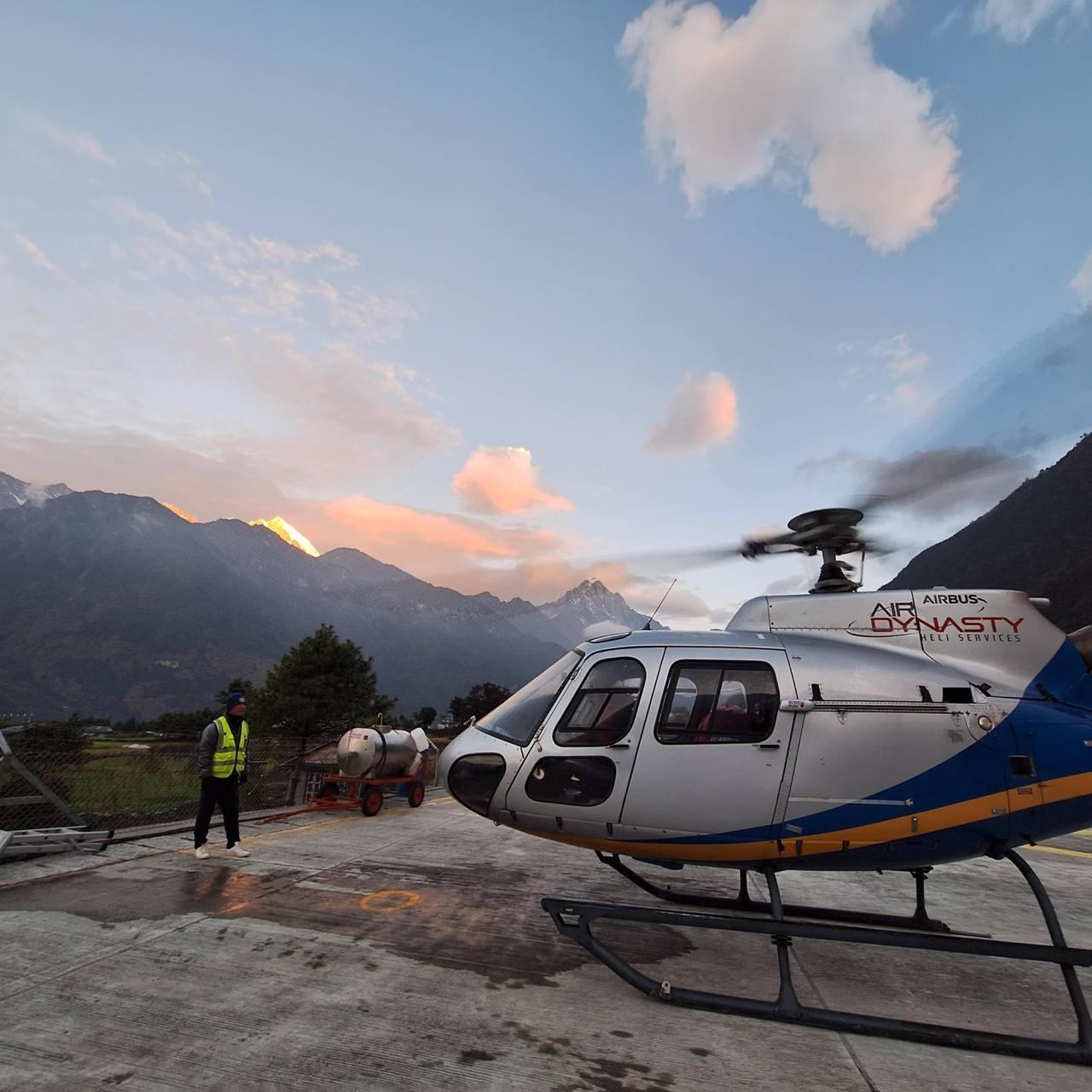
For many travelers, it’s important to be safe and secure, and one way is to choose the ideal season for adventure. The best time to fly to Lukla by helicopter is usually March to May and October to November, when weather is generally better for Everest-region travel. But flights to Lukla depend on the weather all year, so conditions on your flight day matter more than the calendar.
If you are trekking to Everest, you also need to decide how to get to the trailhead. Scheduled fixed-wing flights are cheaper, while a Kathmandu to Lukla helicopter flight gives more flexibility and can save time if your schedule is tight. The helicopter costs more, so it comes down to whether that flexibility is worth the extra cost.
This guide explains Lukla's four main travel seasons, how visibility, cloud, rain, and wind affect helicopter flights, and when a helicopter may make more sense than a scheduled flight.
| Season | Typical travel conditions | Helicopter planning |
| March to May | Spring trekking season, generally favorable conditions | Strong option for trekkers with fixed itineraries |
| June to September | Monsoon rain, cloud and reduced predictability | More weather-sensitive, flexible plans are important |
| October to November | Post-monsoon period and major trekking season | Strong option when conditions are suitable |
| December to February | Cold, lower visitor numbers and possible winter weather | Possible, but allow flexibility for conditions |
Nepal Tourism Board states October to November and March to May are among the best seasons for trekking in the Everest region. It also notes that the Everest trek starts at Lukla, so flight conditions are an important part of the itinerary. The key point is that the calendar does not decide whether a flight can operate. Weather on the day matters. Visibility, clouds, rain, wind, and conditions along the route all affect aviation decisions.
DHM maintains official seasonal outlooks and monthly weather reports for Nepal, while CAAN requires operators to follow aviation rules and obtain weather information before planning and commencing flights. CAAN safety guidance specifically emphasizes weather information and continued compliance with Visual Flight Rules for helicopter operations. If you are comparing travel dates, start with the season, then check the actual forecast and operational availability closer to departure.
A scheduled fixed-wing flight remains a practical way to reach Lukla, particularly for travelers whose priority is keeping transportation costs lower and who can work around an airline schedule. A helicopter serves a different purpose. The higher price can make sense when time, scheduling flexibility, or group arrangements matter more than choosing the lowest-cost transport option.
Check out our blog, Why Helicopter Beat Fixed Wing, to understand even more.
Scheduled airlines operate according to their published schedules and available seats. A helicopter service can be arranged around available aircraft capacity and the operational plan for the day, giving some travelers more flexibility than relying solely on a scheduled airline service.
That does not mean a helicopter can simply depart whenever a passenger wants. Aircraft availability, airport procedures, weather, air traffic, and aviation requirements still apply. For a traveler with a tightly planned Everest itinerary, that distinction can matter. If you have only a limited number of days in Nepal, spending less time waiting for a suitable scheduled flight may be worth the additional cost.
Aero Connect's current price for its shared Kathmandu to Lukla helicopter flight is $540 per person. The listed flying time is approximately 45 to 60 minutes, while the package duration is shown as four hours to allow for check-in, baggage handling, airport procedures, and operational requirements. The published price is for a shared seat, not a private helicopter charter. Rates can change according to travel date, availability, and operating arrangements, so the current quotation should be confirmed before payment.
Yes, generally. A helicopter seat costs more than a conventional scheduled fixed-wing ticket because the aircraft and operation are structured differently. The practical question is therefore not simply whether a helicopter costs more. It is whether the additional cost provides something valuable for your particular itinerary.
A helicopter can be relevant for:
A fixed-wing flight remains appropriate for travelers whose main priority is lower-cost scheduled transportation.
If bad weather disrupts your Kathmandu to Lukla helicopter tour, certain actions are taken almost immediately. If the helicopter is on the ground, the flight may be delayed, rescheduled, or cancelled until conditions improve. However, if the conditions disrupt during the flight, the helicopter pilot will land in a safe place they are flying over until the weather conditions improve.
Helicopter operations in the Everest region depend on visibility, cloud conditions, wind, and other aviation safety requirements, so the pilot and operator make the final decision on whether a flight can proceed. Aero Connect Nepal monitors weather and operational updates and communicates changes to passengers as early as possible.
If your flight cannot operate, our Kathmandu team and representatives in Lukla and other Sherpa settlements help coordinate the available rescheduling or cancellation options according to the booking terms.
Important Note :
A helicopter flight does not eliminate weather risk. It can reduce the uncertainty associated with waiting for a fixed-wing flight, but helicopters also cannot operate when conditions fall outside safe operating limits. Check our weather cancellations and refund policy for more updates.
Spring and autumn are generally the most suitable seasons for a Kathmandu to Lukla helicopter flight, with March to May and October to November offering more favorable mountain visibility and trekking conditions. Winter can also provide clear skies, while the monsoon months from June to September are the least ideal because persistent rain, cloud cover, and reduced visibility can cause frequent disruptions.
Spring is one of the most popular periods for flying to Lukla. Weather is generally more stable than during the monsoon, and mountain visibility is often favorable, particularly in March and April.
May can become busier, and weather conditions can change as the pre-monsoon period approaches. Early morning departures are often preferred because visibility can deteriorate later in the day, but every flight remains subject to current weather and aviation conditions.
The monsoon season is not the ideal period for a Lukla helicopter flight. Heavy rainfall, low cloud, poor visibility, and changing mountain weather can lead to flight delays, rescheduling, or cancellations.
Helicopters can operate when conditions meet safety requirements, but travelers booking during this period should allow extra flexibility in their itinerary. A flight may need to move to another day if weather conditions prevent a safe departure.
Autumn is generally considered the most reliable season for flying to Lukla, particularly from October through November. The monsoon usually clears the atmosphere, improving mountain visibility and creating favorable conditions for trekking and helicopter operations.
This is also one of the busiest periods in the Everest region, so helicopter availability can become limited during peak dates. Booking in advance is advisable, especially if you have a fixed trekking schedule or onward accommodation arrangements.
Winter can offer surprisingly clear skies and excellent mountain views around Lukla. December and January can bring cold temperatures, but dry conditions and good visibility may provide suitable flying conditions on many days. The main consideration is the possibility of winter weather, including snowfall and strong winds at higher elevations. Travelers should still keep some flexibility in their schedule because clear conditions can change quickly in the mountains.
June to September is generally the least suitable period because of the Nepal monsoon. Persistent rain, low clouds, and reduced visibility can create more frequent flight disruptions than in spring, autumn, or the drier winter months. If you must travel during the monsoon, build additional days into your itinerary and avoid scheduling your Lukla flight immediately before an important international departure. Aero Connect Nepal monitors weather and operational conditions and assists passengers with available rescheduling options when a flight cannot safely operate.
Lukla is about 2,850 meters above sea level and is the starting point for many Everest-region treks. The airport sits in mountainous terrain, which creates specific challenges for aviation. CAAN has noted the difficult topography around Lukla and the limited airspace available for aircraft to maneuver.
Several weather factors matter when planning a flight.
Pilots need good visibility to operate safely under the relevant flight rules. Mountain routes can become unsafe when visibility is reduced by cloud, rain, mist, or other conditions.
Cloud can hide mountain terrain and reduce the visual cues needed for safe operation. A clear forecast in Kathmandu does not necessarily mean conditions along the full route to Lukla are suitable.
Rain can reduce visibility and affect operating conditions. This is especially relevant during the monsoon months.
Wind conditions also need to be considered. Mountain valleys can create changing airflow, so the pilot and operator must look at current conditions rather than relying only on seasonal averages.
Lukla's mountain location makes weather assessment especially important. CAAN describes Lukla as being surrounded by high hills and mountains with limited airspace for maneuvering.
Many mountain flights are planned for the morning, but departure time should never be assumed. Weather, airport procedures, air traffic, aircraft availability, and other operational factors can change the actual departure time. The best approach is simple: use seasonal patterns to choose when to travel, then check current weather and operator confirmation to assess the actual flight date.
For current planning, check our Nepal weather in September and October guide before your trip.
Lukla is the practical gateway for the classic Everest trekking route. Nepal Tourism Board identifies Lukla as the "Gateway to Everest" and notes that the Everest Base Camp trek starts from the Lukla airstrip before continuing through the Dudh Koshi valley toward Namche Bazaar. From there, the route continues through Tengboche, Dingboche, Lobuche and Gorak Shep before reaching Everest Base Camp.
For trekkers with a limited number of days in Nepal, getting to Lukla on schedule matters. A delayed flight can affect hotel bookings, trekking permits, guide arrangements, acclimatization days, and your planned arrival at Everest Base Camp. Nepal Tourism Board also describes flying to Lukla as a time-saving alternative to approaching the Everest region on foot from Jiri.
The Kathmandu to Lukla flight is not simply a short domestic transfer. It is the link between Kathmandu and the trailhead used by most trekkers beginning the classic Everest Base Camp route.
Once you land at Lukla, the walking itinerary begins. The first section follows the Dudh Koshi valley toward Phakding and Monjo, followed by the climb to Namche Bazaar, which sits at around 3,500 meters and is an important acclimatization point on the route.
This is why travelers with only two or three weeks in Nepal often pay close attention to their Lukla flight arrangements. If transportation takes longer than planned, there may be less flexibility for acclimatization or scheduled trekking days.
A trekking company can arrange your complete Everest itinerary, including guides, accommodation, and trekking logistics. However, helicopter transportation is a separate aviation service with its own aircraft availability, weather restrictions, departure coordination, and operational requirements.
Using a dedicated helicopter booking company such as Aero Connect Nepal gives travelers a specialist point of contact for the flight itself. Instead of treating the helicopter as one small component of a larger trekking package, Aero Connect focuses on sourcing available helicopter capacity, arranging shared seats or private charters, and coordinating flight information with its operational network.
This can be particularly useful when a trekker needs to change a flight because of weather or adjust transportation around their trekking schedule. Aero Connect Nepal has representatives in Kathmandu, Lukla, Namche, Tengboche, Dingboche and other Sherpa settlements, providing local support as travelers move through the Everest region.
Aero Connect Nepal works as a direct wholesale source for helicopter flight bookings, connecting travelers with available helicopter capacity rather than operating as a trekking company adding a helicopter seat to an existing trek package.
This distinction can matter when you need to compare shared and private flight options, check current availability, or arrange transportation separately from your trekking package. The actual aircraft remains operated by the licensed helicopter company, while Aero Connect handles the flight booking and related coordination.
Within two months of its inception, Aero Connect Nepal has already provided services to 3,000+ customers and successfully conducted 200+ flights across Nepal.
For trekkers who prefer to arrange their complete Everest itinerary through a trekking company, Alpine Aura Trek is one example of a trekking specialist that can manage the walking portion of the journey while trusting Aero Connect Nepal for helicopter services.
Alpine Aura focuses on trekking, guides, accommodation, and mountain logistics, while Aero Connect provides the specialist helicopter booking service. This separation allows each company to focus on its area of expertise while giving the traveler a clear point of contact for the helicopter component.
After landing in Lukla, trekkers normally begin the walking section toward Phakding and Namche Bazaar. Nepal Tourism Board describes the Lukla to Namche section as a two-day trek through the Dudh Koshi valley, with Phakding and Monjo serving as common stops before the route climbs toward Namche.
From Namche, the trail continues toward Tengboche, then Pheriche or Dingboche, followed by Lobuche and Gorak Shep before the final approach to Everest Base Camp. Because altitude increases significantly along this route, the trekking schedule needs to allow sufficient time for acclimatization rather than treating every day as a fixed-distance transfer.
For travelers arranging their own transportation, the key decision is therefore not simply whether to fly or trek to Lukla. It is choosing a flight arrangement that fits the trekking itinerary while leaving enough flexibility for the weather and operating conditions that affect mountain aviation.
Here is the ideal way to plan your Kathmandu to Lukla helicopter flight.
Start with the season that fits your Everest itinerary.
For most travelers, spring and post-monsoon autumn are the principal periods to consider. Monsoon requires more flexibility, while winter requires preparation for colder conditions.
Review official DHM information and current forecasts close to your travel date.
Do not rely on a seasonal description alone. A normally favorable month can still produce an unsuitable flight day.
Helicopter flights depend on aircraft availability and operational planning. Confirm the actual date, passenger details and current price before making final arrangements.
Aero Connect's current listed shared rate for Kathmandu to Lukla is US$540 per person, but the current quotation should be confirmed at the time of booking.
Baggage capacity on helicopter services is different from simply assuming the allowance of a scheduled airline.
Passenger weight, baggage weight, aircraft payload and operating conditions can affect loading. Confirm your baggage allowance before departure.
This is particularly important during monsoon and winter, but it is sensible in every season. Do not build your Everest trek around an assumption that the aircraft will depart at a fixed time regardless of conditions.
If you are booking through an agency, ask which licensed operator will conduct the flight. CAAN regulates helicopter operations in Nepal, and its Flight Operations Requirements include specific requirements for helicopter operations. For practical guidance, read our checklist on Helicopter Operators in Nepal — Certification, Regulation, and How to Choose a Safe Operator.
A shared helicopter seat may be appropriate for an individual traveler or couple. A private charter may make more sense for some groups, but the price and aircraft arrangements are different. The current Aero Connect listing distinguishes the shared Kathmandu to Lukla service from private helicopter charter arrangements.
If you already have your Everest trekking dates, check the current Kathmandu to Lukla helicopter flight availability and price before finalizing your itinerary.
If you are returning from the Everest region by air, see the Lukla to Kathmandu helicopter flight option as well.
For travelers who prefer the Everest region, you can book your preferred helicopter tour and enjoy a once-in-a-lifetime experience.
October to November and March to May are generally the best periods for a helicopter flight to Lukla because weather and visibility are more favorable. Early morning departures are often preferred, although flights remain subject to actual weather and operating conditions.
A shared helicopter flight from Kathmandu to Lukla commonly costs around $500 to US 700 per person, while a private charter costs more depending on aircraft capacity and group size. Prices can change by season, availability, fuel costs, and whether the flight is one-way or part of a larger itinerary.
October and November are among the most popular months for Everest Base Camp helicopter tours because they typically offer clear mountain views and stable autumn weather. April and May are also strong months, particularly for travelers who want spring conditions and good visibility before the monsoon.
A helicopter typically covers 100 km in roughly 30 to 40 minutes, depending on its cruising speed, altitude, wind, and flight route. Himalayan flights can take longer when pilots need to adjust the route for weather, terrain, or air traffic.
Helicopter flights to Lukla involve mountain weather and high-altitude risks, so flights operate only when pilots and aviation authorities consider conditions suitable. Professional operators follow regulated flight procedures, but weather can still cause delays, diversions, or cancellations.
Yes, helicopters can fly in the Everest region and provide aerial views of Mount Everest, but flight routes and altitude are subject to aviation regulations, weather, aircraft performance, and operational limitations. Everest Base Camp helicopter itineraries generally use approved routes and landing points rather than simply flying directly over the summit.
October to November and March to May generally offer the most reliable flying conditions, with clearer skies and better mountain visibility. Weather can still change quickly in the Himalayas, so every flight remains subject to actual conditions on the day.
Helicopters can operate during some monsoon periods, but frequent cloud, rain, and reduced visibility can cause delays or cancellations. July and August generally have less reliable flying conditions than the main trekking seasons.
Early morning is generally preferred because mountain weather and visibility are often more favorable before clouds build later in the day. Your actual departure time depends on weather, air traffic, airport conditions, and the operator's flight schedule.
A direct helicopter flight from Kathmandu to Lukla typically takes around 45 to 60 minutes, depending on weather and operating conditions. The flight is substantially faster than traveling by road and fixed-wing aircraft connections.
Yes, helicopters can operate to Lukla during winter when visibility, wind, and other flight conditions are suitable. December through February can bring cold temperatures and occasional weather disruptions, but clear days can provide excellent mountain visibility.
If weather makes the flight unsafe, the departure should be postponed or cancelled rather than operated in unsuitable conditions. A clear cancellation and rescheduling policy should be confirmed when booking so you know how your payment is handled.
A helicopter provides greater flexibility because it can operate without relying on the same fixed-wing airport schedule and can be used for private or shared transfers. Fixed-wing flights can be more economical when operating normally, while helicopters are often chosen when flexibility, direct access, or group arrangements are priorities.
Yes, helicopters can fly from Lukla toward Everest Base Camp or nearby landing areas when weather, altitude, regulations, and operating conditions permit. Depending on the itinerary, passengers may land at designated locations such as Kala Patthar for mountain views rather than landing directly at Everest Base Camp.
Wear warm, layered clothing and comfortable footwear because temperatures can be much colder around Lukla and higher Himalayan landing points. Sunglasses, sun protection, and clothing suitable for sudden weather changes are also useful, particularly for itineraries continuing toward Everest Base Camp.